
Road To Nowhere
‘Well, we know where we’re goin’
But we don’t know where we’ve been
And we know what we’re knowin’
But we can’t say what we’ve seen’
‘Road to Nowhere’ – Talking Heads
One of my favourite bands from the 1980’s were the Talking heads. They had a hit in the mid-eighties called ‘Road to Nowhere’ from the album ‘Little Creatures.’ The song came to mind recently whilst watching the BBC programme ‘Pilrimage: The Road to Istanbul’ (first aired in march 2020.)
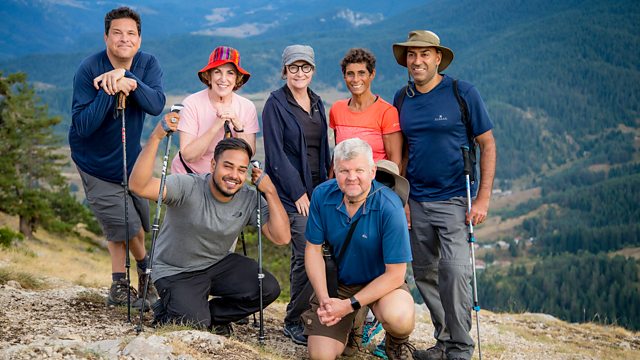
Seven celebrities were chosen to undertake a walking ‘pilgrimage’ from Belgrade in Serbia to Istanbul in Turkey. From loose faith affiliations to definite atheists, none of them had what could be described as any traditional belief. The only practising Catholic, Adrian Chiles, proudly proclaims,
“Well, I found I’ve got more in common with a liberal Muslim, Mim, for example, than I would probably have with a conservative Roman Catholic.” Not that there was a conservative Roman Catholic travelling with them for him to make that discovery! Pauline McLynn (who played the housekeeper from Fr Ted) tells us, “I don’t need organised religion. Embracing people and nature and trying to do as little harm within that as possible is enough for me.” The writer and comedian, Dom Joly, announces his take on religion, “I don’t think that having an imaginary friend would help me make sense of anything but if it works for you and you don’t try to impede my life because of your faith, then crack on.” Joly came closest to being engaged by religion when he got excited about a Sufi drum circle and chanting. At the end of the ‘pilgrimage’, Joly proclaims, “My lack of faith remains absolutely consistent.” In fact, by the end, most of them had been little impacted by any experience of faith. So what was the point, we might ask?
I’m not sure if you can build your own ‘al a carte’ religion, religion being very much a social product. There seems to be this secular modernist attitude, though, that there are a few positive things from all the worlds religions and that those positive aspects don’t conflict. Why can’t we just bring them all together in a melting pot of love and harmony? Sure, hasn’t religion been the cause of all wars? And at the end of the day, religion is just a personal choice, right? Whilst I don’t embrace a full blown conspiracy theory of ‘One World Order’ creating a ‘One World Religion’, I do find this growing syncretism, with regard to religion, a little disturbing. Pope Francis with his ‘Human Fraternity’ accords with the Grand Imam of al-Azhar Al Sharif in 2019, highlights these growing concerns. Seeking peace and focusing our common human origins in Adam is all well and good but when it comes with an instruction not to ‘proselytize’, when it comes to not exploring the fact that Christianity has always seen Islam as a heresy (in similar terms to the heresy of Arius) then we really are papering over the surface to cover the big cracks! Any practitioner who is inspired by and loves their faith will want to find out about it. Will want to search the hidden depths of their faith tradition, not go skirting around the peripheries. (This doesn’t mean that we therefore end up declaring war on other religions!) The only hint I got of this desire came from our Muslim celebrity, Mim Shaikh, who reflected at the end, “I know that my faith has increased and become that bit stronger.” In fact this whole journey was one of travelling away from Europe and Christianity and heading towards Islam.
Pilgrimage is a spiritual journey, made in a practical way. The journey is an opportunity to grow in your practice and understanding of a faith, but the destination is where you want to end up. The destination is where you want to arrive at and (in spiritual terms) remain. It is usually in honour of a saint or founder of a particular religion. Some of the most famous traditional pilgrimage routes in Christianity are to Jerusalem, Santiago de Compostella and Lourdes. In Islam the most famous is the Hajj to Mecca. So what was the destination for our secularist pilgrims? The tomb of Suleiman the Magnificent at the Süleymaniye Mosque in Istanbul. Suleiman was the longest-reigning Sultan of the Ottoman Empire from 1520 until his death in 1566. His desire was to conquer as much of Christian Europe as possible. He was very successful, only being stopped at the gates of Vienna in 1529. I can’t say for certain that this is what the BBC producers were consciously projecting and celebrating but it did seem rather strange. Surely Jerusalem, with it’s shared heritage between Muslim, Jew and Christian, would have been more fitting?
A secularist programme for a secular age, it used the iconography of religion to make a pleasant travelogue and human friendships story. As with any icon you can just stop and look at it and then walk on by. This is exactly what this programme did. Any Orthodox Christian will tell you that an icon is a ‘window on the soul’ and that you are invited to ‘enter in.’ Adrian Chiles was asked if he would do it again and his reply was very telling, “For me walking is more about solitude and peace so not sure if pilgrimaging is really for me.” Yes, the whole point of a pilgrimage is that you are challenged…speaking from my own experience, it is rarely a holiday!
Road to Nowhere? The Talking Heads single cover expressed it quite well…

 Brother Alberic