

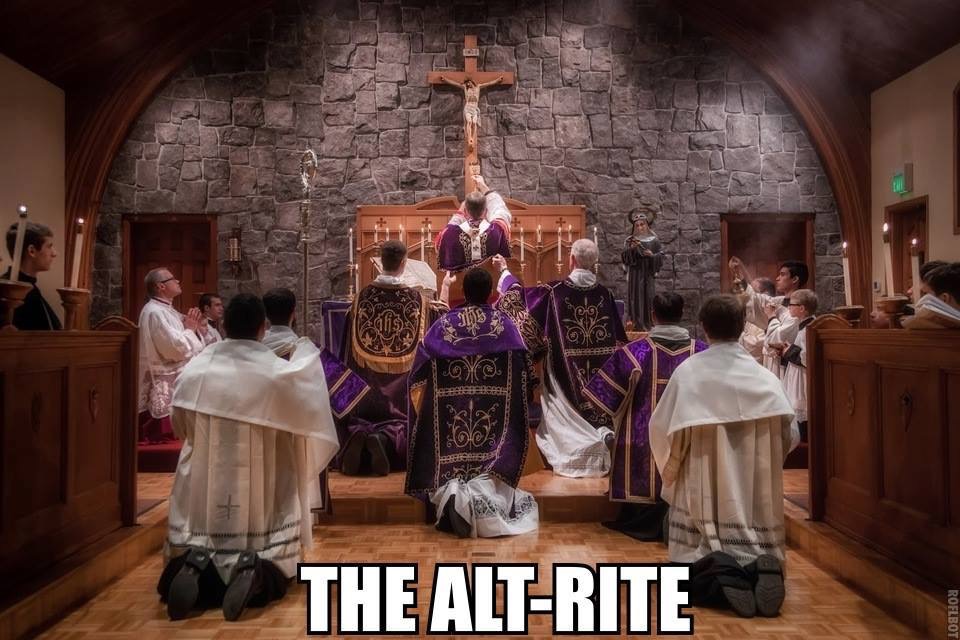
Then he brought me to the gate, the gate facing east. And there, the glory of the God of Israel was coming from the east; the sound was like the sound of mighty waters; and the earth shone with his glory. The vision I saw was like the vision that I had seen when he came to destroy the city, and like the vision that I had seen by the river Chebar; and I fell upon my face. As the glory of the Lord entered the temple by the gate facing east, the spirit lifted me up, and brought me into the inner court; and the glory of the Lord filled the temple.
Ezekiel 43:1-5
I recently watched a commentator decry the November National Memorial Mass from Knock in that there were 26 priests and bishops present and not one of them ministered the Eucharist to the congregation. In fact, a lay minister of the Eucharist gave the Blessed Sacrament to priests not at the altar. Why is this noteworthy, you may ask? I think it could be indicative of a greater malady in the church regarding belief in the real presence and devotion to the blessed sacrament. The priest is the person consecrated to minister the blessed sacrament to the people as he stands ‘in persona Christi.’ The extraordinary lay minister of the Eucharist only steps in to help if the numbers are too great for the priest alone. It has always been part of Catholic tradition to receive from the priest, on the tongue and kneeling down. Sadly this practice seems to be disappearing along with a belief that God is fully present, body, soul & divinity in the host.
Followers of the Traditional Latin Mass (TLM) within the church, will point to the decline in worship, belief and attendance at mass being a result of the reform of the liturgy in 1970. Despite the fact that I think the decline in the west would have happened regardless of what rite we celebrated, I do think that they have a point in highlighting a lack of reverence at many of the regular Novus Ordo masses in Western Europe and America.
In 2007 Pope Benedict XVI issued Summorum Pontificum, which declared: (1) any priest could celebrate the TLM without explicit permission of his bishop; and (2) the TLM was never abrogated. The pope wrote that “What earlier generations held as sacred, remains sacred and great for us too, and it cannot be all of a sudden entirely forbidden or even considered harmful.” This was a measure that I sensed at the time would be good in healing the growing rift between followers of the Traditional Latin Mass and most of the rest of us who attended the Novus Ordo mass instituted by Pope Paul VI in 1969. Sadly this has been somewhat revoked by Pope Francis. Who has called the followers of the TLM ‘rigid’…so who’s right about the rite?
The glib closure by the Irish government of churches at the start of this year of 2021, came with flippantly telling us that our services could ‘move on-line.’ This was a demonstration, if ever there needed to be, of the lack of awareness of what it means to be a Catholic Christian. Our worship is sensory, tactile, ambient and kinaesthetic. It cannot be replaced by a TV screen. I could not watch a regular mass on-line so I set myself the task of brushing up on my Latin and watched the traditional Latin High Mass from the Institute of Christ the King in Limerick. A few weeks back I visited there myself. Besides the beauty of the mass itself, what struck me was the fullness of the church with a good mix of congregants. There were plenty of families with young children alongside a good mix of ages of people on their own or in groups. This is a thriving community that needs to be listened to.
One thing I did in that listening process was to engage with what traditionalists were saying on-line. One thing that was pointed to was the discrepancy between what the Second Vatican Council was calling for and the liturgical reforms as they presented themselves in the Novus Ordo of 1970. So I read Sacrosanctum Concilium, the Constitution on the Sacred Liturgy. It is surprisingly concise and easy to read. What struck me most was that while it was calling for a ‘simplified’ liturgy, it wasn’t calling for any drastic changes…
there must be no innovations unless the good of the Church genuinely and certainly requires them; and care must be taken that any new forms adopted should in some way grow organically from forms already existing.
( Sacrosanctum Concilium 23)
It called for the retention of Latin and that the vernacular was to be used sparingly (S.C. 36). It proclaimed that Gregorian Chant and the pipe organ where to remain central to worship (S.C. 116&120).
So what was Pope Benedict trying to do when he released ‘Summoram Pontificam’? Maybe it was a recognition of what the Second Vatican council was calling for and that we have strayed from that vision. I think it was the hope that the TLM could help reform what the Novus Ordo has become and make it more reverential. I found it interesting that The Benedictine Community of Chilworth (where I did my Franciscan noviciate) have responded to this call by saying the Novus Ordo mass in English but using the High Altar again with priest and people ‘ad orientum’.
There are many ways we can make the regular mass more reverential and the TLM can give us many pointers, even if we don’t revert to its full use. The ex-Anglican Ordinariate can also help the rich mix and understanding of sacred liturgy (but that’s a whole story in itself…other than to say that the first all-Latin Eucharist that I went to was Anglican). The popularity of the TLM could well be a move of the Holy Spirit. Labelling its followers ‘rigid’ is not helpful as rigidity can apply to all wings and movements of the church.
It’s such a shame that the sacred liturgy has been a cause for much division in the church lately. As it is divinely instituted, there must be a Catholic understanding of the Mass upon which we can all agree even if our celebrations might differ.
The criterion that assures unity amid the diversity of liturgical traditions is fidelity to apostolic Tradition, i e., the communion in the faith and the sacraments received from the apostles, a communion that is both signified and guaranteed by apostolic succession.
It is fitting that liturgical celebration tends to express itself in the culture of the people where the Church finds herself, though without being submissive to it. Moreover, the liturgy itself generates cultures and shapes them.
(Catechism of the Catholic Church 1209 & 1207)
So who is right about the rite? Well Pope Benedict was along the right lines…but that’s just my opinion! Whatever our opinion we must never lose sight of the words of Jesus in wanting his followers to worship in ‘spirit and truth’. (John 4:24)
 Brother Alberic