

“Whoever is not with me is against me, and whoever does not gather with me scatters. And so I tell you, every kind of sin and slander can be forgiven, but blasphemy against the Spirit will not be forgiven. Anyone who speaks a word against the Son of Man will be forgiven, but anyone who speaks against the Holy Spirit will not be forgiven, either in this age or in the age to come.” (Matthew 12:30-32)
When I first read this scripture I was quite shocked (Jesus has a habit of doing this to his followers!) The Lord is all forgiving, so I thought. Well he is when it comes to him…utter all manner of blasphemies against the person of Jesus and they can be forgiven. Not so, the Holy Spirit. So what exactly does this mean? Many have their own take on this so here’s mine. I think the key element to this is what transpires at the beginning of this passage. A blind and demon-possessed mute is brought before Jesus who heals him so that he can then talk and see (Matt 12:22). “Is this the Son of David,” the people ask? At which the Pharisees accuse Jesus of healing the man in the name of Beelzebub. This is an obvious distortion of the Truth that Jesus proceeds to point out to them…how could, and why would a demon seek to cast out another demon, as, a ‘household divided against itself will not stand.’ (Matt 12:25) It’s an obvious lie and distortion of the truth. What Jesus is saying is that those that deliberately distort truth for their own benefit will be caught up in a web of deceit that will be impossible to extricate oneself from.
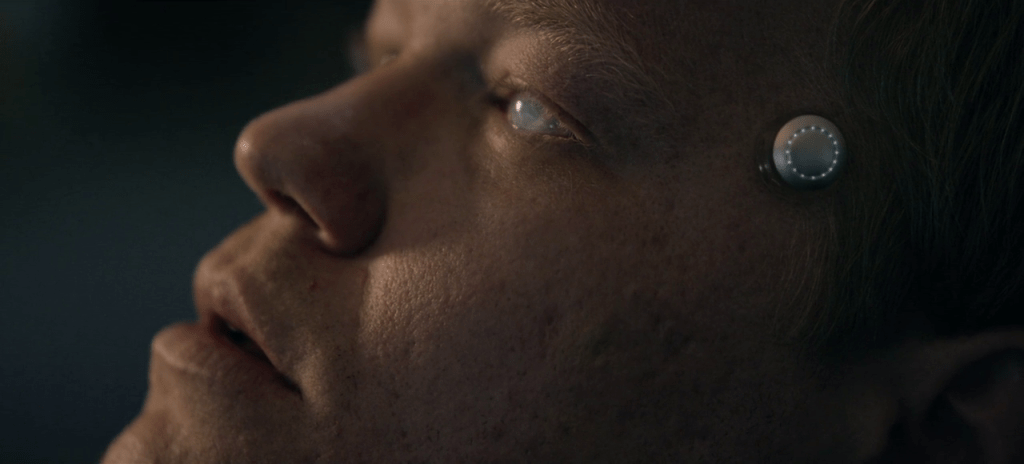
The often harrowing TV series Black Mirror, with its dystopian tales, has an episode called ‘USS Callister’ (Season 4 Episode 1.) The main character, Robert Daly, is a gifted but reclusive programmer. He is the co-creator of a hugely successful on-line game but is embittered and resentful of his co-workers who he feels do not give him the recognition he deserves. To get back at them he creates a ‘Star Trek’ type game within the game. He is able to make clones of his work colleagues from captured DNA and puts these clones into his game. He enters the game at will, as the captain, and proceeds to dominate his crew. When he clones a new member of staff, this new clone finds a way to contact the real world. Through this contact the clones gain access to a new updated version of the game. The crew manage to capture the main ship and Daly has to pursue them in a smaller craft. After a chase through an asteroid belt the crew of the USS Callister manage to jump into the new updated game whilst Daly is blocked by a firewall. He is unable to return to the real world and is trapped inside his small craft screaming, to no avail, ‘end game, end game!’ The outside universe begins to crumble as the old game malfunctions. We then see the ‘real’ body of Daly at home, slumped, motionless in his armchair.
This episode reminded me of Matthew 12. When we create an alternative world for ourselves based on lies and resentments, do we not put ourselves into a trap from which we can’t escape? We seem, more and more, to be creating and living in a fantasy world. Remote working, remote learning, remote transport. Creating online personas for ourselves. Thinking we can be anything we choose to be. We can end up being disconnected from God and other people.
It is easy to jump into fantasy and illusion as a way to escape the trials of our real lives. When Jesus tells everyone of us to take up their cross (Matthew 16:24) he is telling us to cling to truth in embrace of the suffering we go through in this life. An embrace that leads to our own resurrection and into fullness and newness of life. Jesus doesn’t want us to get trapped in a denial of the workings out of his plan of salvation. So I think his teaching on the sin against the Holy Spirit warns us against this. Does this preclude our ‘imaginative’ selves? By no means. Being rooted in reality means we are free to express our imaginations rather than our imaginations becoming some sort of concrete reality. Chesterton explains this well in the chapter ‘The Maniac’ from his book Orthodoxy. Our unknowing, rooted in trust, is explored as mysticism, ‘Mysticism keeps men sane. As long as you have mystery you have health; when you destroy mystery you create morbidity’ (Orthodoxy p.23/ centennial edition, Torode Book Arts, Nashville.)
Are we creating, more and more, a fantasy world rather than living the reality of life as is? Are we disconnected from others and disconnected from living in ‘humility,’ that earthy and natural existence that the word implies? When we don’t seek truth, when we create fantasy and illusions and constantly dwell therein, do they not become a ‘new reality?’ A new reality cut off from the source of life and love…God himself. Does a consistency of living in this ‘new reality’ create a permanence in and of itself? One from which it is difficult, dare we say impossible to escape. Could there be a situation we create for ourselves when we cry out, ‘end game, end game!’ to which there is no response…indeed the game we have created crumbles about us? Lord, keep us real, keep us true, keep us honest and transparent. Let us always seek and be grounded in your Truth and not stand with Pilate when he proclaims ‘what is truth,’ believing we can be and create anything we desire.
 Brother Alberic