

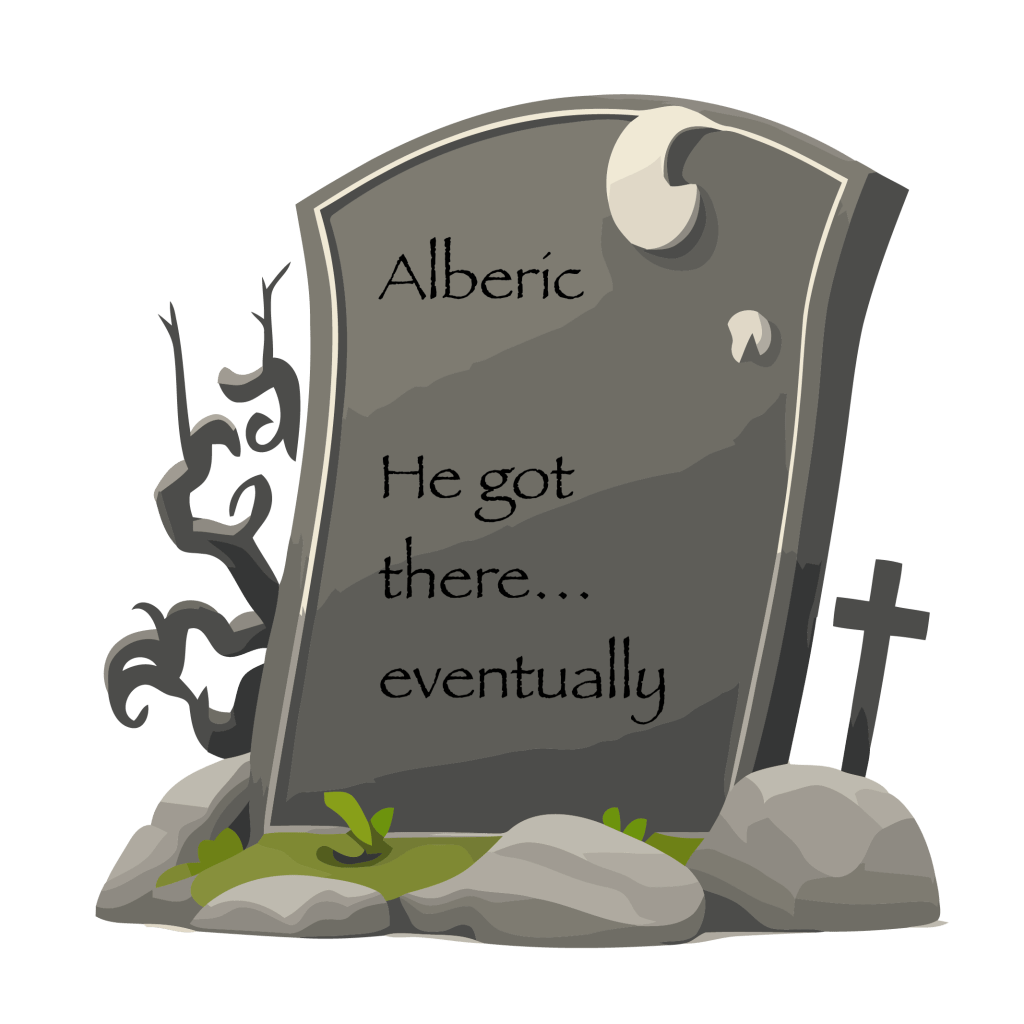
Alas poor Alberic, I knew him well! I was pondering on my death recently and what would be written on my tombstone. And then I thought that if I stayed in the monastery I wouldn’t have a tombstone but a simple cross, yes the cross of Jesus Christ – that which cuts through all pretense. After being distracted by the distraction I returned to the tombstone. Yes, what I would like I thought, would be “He got there…eventually!” all of this pondering was going on in my head…during mass! I was suddenly brought to attention by recovering the awareness of my responsibilities. I had to ring the bell at the elevation of the blessed sacrament. I was a few seconds behind and had almost forgotten it. I frantically reached for the red button at the top of the box that controls the bells electronically…then I was back in fantasy land again seeing the grey box with a red button on top as a detonator for an explosive devise. I had to blow the bridge before the enemy crossed over and took possession of our station! I was just in time – we were saved…indeed we have been saved by receiving Jesus into our very being…he who has been lifted up for all the world to see.
I recounted my noticeable delay in ringing the bell later on to a brother. Suggesting that I be sacked from my job, I explained that I had been “away with the fairies.” I have always known fairies to be mischievous. When I was young and the family went down to Kent from London, my father would always drive through this wooded road called Iffin Lane (which almost spells Elfin Lane!) He would deliberately make our camper van shudder by going on and off the accelerator pedal quickly. To squeals of horror and delight we children knew we were under a fairy attack. From thence forth I knew for certain that fairies were not benevolent! In some Christian traditions fairies are seen as fallen angels, not good enough for heaven yet not bad enough for hell. They are seen in effect as a lesser demon…if there can be such a creature! Whatever they are I think that they are the source of distraction, especially when something important is about to take place. Whereas demons can lead our thoughts into very dark and desperate places, fairies are the big distractors. They can direct your attention elsewhere when it could be on something much more valuable.
Fairies are very popular today with children and adults. You can get a fairy to visit your school. You can go on a fairy tour or visit an enchanted garden. The trouble is, enchanted has a double meaning. It can mean a place filled with delight. To delight in the natural world is a good and beautiful thing, as long as with St. Francis we can recognise Him who made it so – going deeper into its meaning. If we stay on the surface we can drift into the pagan worship of the created. We can become enchanted according to its other meaning – that of being under a spell. Our current culture sees fairies in this first sense as being purely benign. It misses half the equation and can lead us unbeknown into the world of the demonic. At a Catholic school where I used to work, an outside ‘Fairy Garden’ was made for the younger children. There was a box for the children to post their worries that they wrote out on a piece of paper for the fairy to sort out. Whilst on the surface very beautiful this always struck me as a lost opportunity. It could have been a ‘Saints and Angels’ garden and a teaching opportunity for the children to learn about their Guardian Angel and the array of Saints in heaven that we can call upon for help. Whilst the fairies may be distractors, angels behold the face of God and can be our link and ‘attractor’ to communion with God. “See that you do not despise one of these little ones; for I tell you that in heaven their angels always behold the face of my Father” (Matthew 18:10).
So my thoughts of tombstones and detonators, though not an unusual occurrence, could well be described as ‘wild’ and unruly. These wild thoughts as distractors were described by St. Athanasius in his life of St. Anthony (of Egypt) as “a dust cloud of debate.” The devil tried to dissuade Anthony of his call to follow God in the solitary life by presenting him with thoughts and reflections, “ whispering to him the remembrance of his wealth, care for his sister, claims of kindred, love of money, love of glory, the various pleasures of the table and the other relaxation of life.” St. Anthony recognises the attack and returns to his awareness of the divine call on his life. “But when the enemy saw himself to be too weak for Antony’s determination, and that he rather was conquered by the other’s firmness, overthrown by his great faith and falling through his constant prayers.” (St. Athanasius’ ‘Life Of St. Anthony’ Chpt. 5)
Returning continuously to prayer is a theme in the writings of St Teresa of Avila. Scattered thoughts are described as wild horses…
There are some souls and minds so scattered they are like wild horses no one can stop. Now they’re running here, now there, always restless. [And if the rider is skillful, there is not always a danger – just sometimes. But even though his life is in no danger, he is not free from some dishonor in mounting the wild horse; and there is always some hardship].
The Way of Perfection, Chapter 19
St Teresa indicated that accepting our crazy thoughts is a hardship akin to accepting the cross of Christ. That it is a weakness and in accepting our weakness we are relying on God’s grace and not our own strength. And that when we don’t know how to pray the Holy Spirit intercedes on our behalf with sighs deeper than words (Romans 8:26-27). Our goal is not to achieve some state of thoughtlessness but to encounter, in a deeper way, the presence of the God who loves us. Thoughts can detract from this goal or lead us further towards it. St Teresa herself when distracted in prayer would resort to spiritual reading, in effect replacing the wild horse thoughts with those focused on God. Prayer as a reorientation to that meaningful encounter with The Lord, requires of us some control of wayward thoughts. This can be aided by all types of meditative prayer such as The Rosary or The Jesus Prayer, or in a turning to the scriptures in Lectio Divina.
If the Holy Spirit can aid us in our prayer, sometimes we need to discern whether we are being distracted by the Spirit or by the fairies. Sometimes the wild horses of our thoughts are good and can lead to imaginative reflections that can create insights and understanding. Sometimes they just appear silly and irrelevant and can be ignored. Sometimes they are a distraction from what is going on around us that is important. Then we need to ignore them and bring ourselves to attention and a focus on what is happening. Sometimes our thoughts are very negative and self-defeating and we need to find ways to suppress them (the ‘stinking thinking’ of the 12 step programme teaching.) With all of this we need to discover the ‘wisdom to know the difference’ so that our serenity can be restored. Whatever the nature of the wild horses that are surrounding our interior castle (be they in need of taming or to be ignored), it is always our task to seek that inner room where our soul encounters God, where we behold the presence, where the Holy Spirit intercedes on our behalf with sighs deeper than words. To enter into that trinitarian love of God…may he guide you there – thoughts and all.
We cannot stop the revolution of the heavens as they rush with velocity upon their course, neither can we control our imagination. When this wanders we at once imagine that all the powers of the soul follow it; we think everything is lost, and that the time spent in God’s presence is wasted. Meanwhile, the soul is perhaps entirely united to him in the innermost mansions, while the imagination is in the precincts of the castle, struggling with a thousand wild and venomous creatures and gaining merit by its warfare. Therefore we need not let ourselves be disturbed, nor give up prayer, as the devil is striving to persuade us. As a rule, all our anxieties and troubles come from misunderstanding our own nature.
St Teresa of Avila – ‘The Interior Castle’ – The Fourth Mansions – Chpt 1:9
 Brother Alberic