
But we have this treasure in earthen vessels, to show that the transcendent power belongs to God and not to us. We are afflicted in every way, but not crushed; perplexed, but not driven to despair; persecuted, but not forsaken; struck down, but not destroyed
2 Corinthians 4:7-9
I am not a big fan of Richard Rohr OFM. Probably because I travelled all the way from Kerry to Dublin to hear him speak and he arrived late without apology and only spoke for 10 minutes! It might also be to do with his perceived syncretist and universalist theologies. But I admire him in one respect and that is the work he has done in male spirituality and with mens groups. In 20I0 I travelled to Perth in Scotland from Kerry, a lot further than Dublin – and was not disappointed this time, to attend one of his Men’s Rites of Passage retreats. These retreats were set up to address a severe lack in our modern world of any rituals that mark the transition of boys into men.
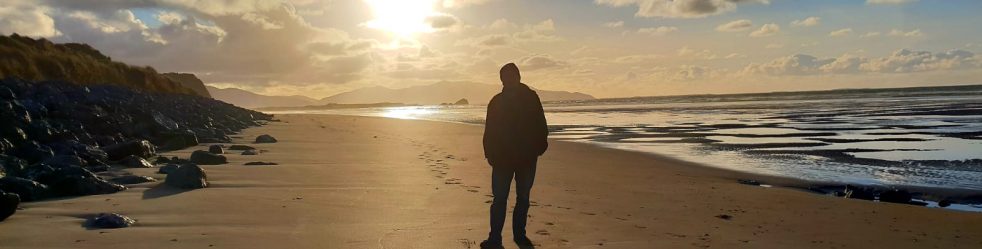
One of the exercises was called a ‘wilderness day.’ We were set off trekking alone along this afforested mountainous area above a river. After we had estimated a certain time we were asked to rest and mark out a circle on the ground with whatever we could find about us, twigs, stones etc. We sat in our circle for six hours, not going outside the boundary we had made. We had been given five envelopes and were asked to open them in order, one on every hour that we guessed had passed (not having any phones or watches). The messages in the envelopes presented us with questions to think about – I can no longer remember what they were but I do remember how surprised I was at being able to guess when an hour had passed. When the six hours had passed a rams horn was blown and we were encouraged to go down to the river and renew our baptismal vows. This I duly did, stripping off and plunging into the icy cold water to renew my rebirth in the Living God. It was a powerful experience that will stay with me forever. Not just the powerful symbolism of it all but the encounter with my own restlessness and wanderlust. I highly recommend it. If you want to know God, go halfway up a mountain and sit in your own circle for half a day – or a full day for those brave (or crazy) enough.
The ‘Desert Father’ Abba Moses, knew well enough how important the getting to know ourselves is, rather than chasing after distractions – which sometimes can come in the form of spiritual teachers.
A brother came to Scetis in the Egyptian desert to visit Abba Moses and asked him
“Father, give me a word.” The old man said to him
“Go, sit in your cell, and your cell will teach you everything.”
St Catherine of Siena knew of this well when she recounted what Jesus had said to her. “Do you know who you are and who I am? If you know these two things, you will be blessed and the Enemy will never deceive you. I am He who is; and you are she who is not.” Catherine knew she was not the one. She knew that her life would only make sense in abandonment to God. True peace lies only in our focus being upon our creator and his will for us.
Getting to know and being honest with ourselves with no distractions is an uncomfortable process, to say the least. Erik Varden, in his book ‘Chastity’, sums up this ‘coming home to ourselves’ in his introductory chapter when he says, “the experience may recur at different times in life and in different ways. There can be joy in it. There can also be a sense of agonizing conflict. Who has not, at one time or another, stood aghast in front of the bathroom mirror forced to admit what Paul bravely confessed to the Romans, “I do not understand my own actions” (Rom. 7:15)? We are often a riddle to ourselves.” (Chastity: Reconciliation of the Senses Erik Varden) The depths of our yearning and longing, the vastness of our disappointments, the struggles in relationship with others, the desire for meaning; all these these processes cannot be born alone. This is where we discover our dependence on God, the higher power, the unknowable source of all that is. This is why taking an honest look at ourselves is difficult without relating to the why of our existence.
I can be a fierce critic of Islam at times but there are many beautiful things regarding the practice of that religion. Muslims can have a great sense of God as transcendent (they just miss out the incarnational bit!). I studied Islam as part of my undergraduate degree and read one book recounting a pilgrimage to Mecca, the Haj. In it the author explained the positions the muslim takes up during prayer. The body forms correspond to the letters in Arabic that spell the word “man”. This is a very visual presentation of man in his lowliness presenting himself before God in his greatness. A very concrete presentation of St. Catherine’s, ‘she who is not approaches you who are.’
This focus used to take pride of place in our liturgy. We were once all turned together to face God….knowing that he is the One and we are not. As a result of the liturgical reforms of the 1970’s the priest is now the sole focus and is required to put on a good show, making sure to throw in an odd joke or two to get the ‘audience’ engaged with his performance.
Pope Benedict XVI described this well in his book The Spirit of The Liturgy:
Now the priest becomes the real point of reference for the whole liturgy. Everything depends on him. We have to see him, to respond to him, to be involved in what he is doing. His creativity sustains the whole thing. Not surprisingly, people try to reduce this newly created role by assigning all kinds of liturgical functions to different individuals and entrusting the “creative” planning of the liturgy to groups of people who like to, and are supposed to, “make their own contribution”. Less and less is God in the picture. More and more important is what is done by the human beings who meet here and do not like to subject themselves to a “pre-determined pattern”. The turning of the priest towards the people has turned the community into a self-enclosed circle. In its outward form, it no longer opens out on what lies ahead and above, but is closed in on itself. The common turning towards the East was not a “celebration towards the wall” ; it did not mean that the priest has his “back to the people” : the priest himself was not regarded as so important. For just as the congregation in the synagogue looked together towards Jerusalem, so in the Christian liturgy the congregation looked together “towards the Lord”.
‘The Spirit of The Liturgy’ Joseph Cardinal Ratzinger p. 94
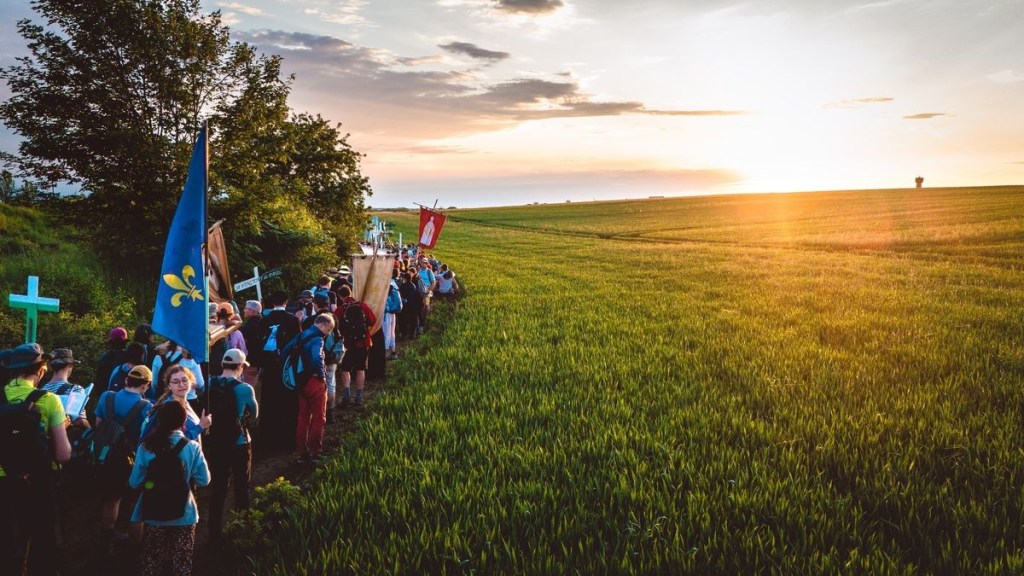
In suggesting a return to ad orientem worship, Pope Benedict reflects on both Jewish and Muslim worship in its direction towards place. In worshipping the one who is for all mankind what better way than to face the rising sun in anticipation that Jesus will come again in glory!
The cosmic symbol of the rising sun expresses the universality of God above all particular places and yet maintains the concreteness of divine revelation. Our praying is thus inserted into the procession of the nations to God.
‘The Spirit of the Liturgy’ p.90 Joseph Cardinal Ratzinger
…and as the psalmist says, “what can bring us happiness, many say. Lift up the light of your face on us oh Lord” (psalm 4:6) The light of the Lord’s face is the source of our Joy, what better symbol of this than the rising sun? Discovering our joy in the Lord means discovering who I am, warts and all! Discovering that there is more than ‘me’. Discovering God as the ‘other’ who take the focus off ourselves. Help us Lord to be discoverers, intrepid explorers of the soul, so that we can stand ready as the bride about to receive her loving husband.
No, you are not the one but you are invited to reorientate yourself to the one who is.
Then I heard what seemed to be the voice of a great multitude, like the sound of many waters and like the sound of mighty thunder peals, crying,
“Hallelujah! For the Lord our God the Almighty reigns.
Let us rejoice and exult and give him the glory,
for the marriage of the Lamb has come,
and his Bride has made herself ready;
Revelation 19:6-7

 Brother Alberic