

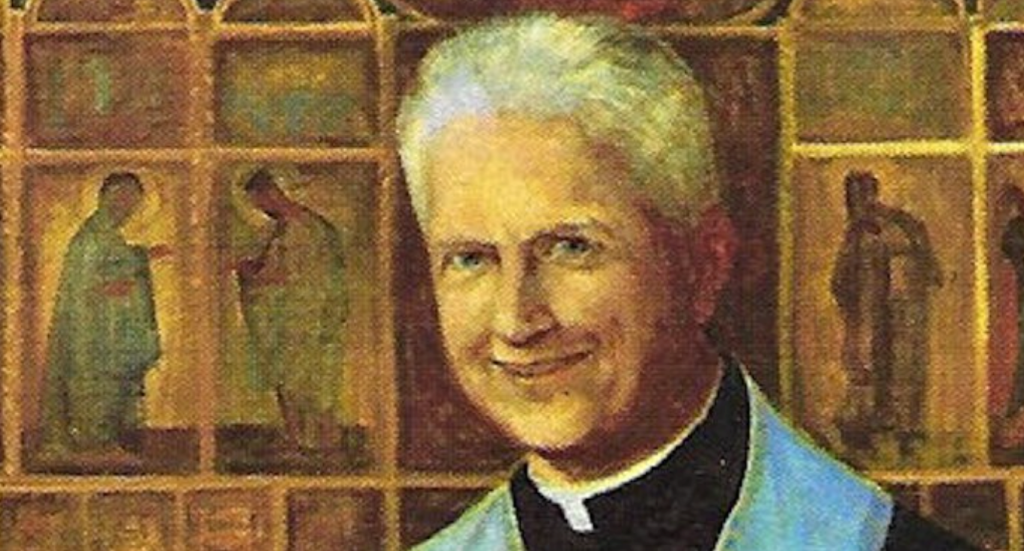

This simple truth, that the sole purpose of man’s life on earth is to do the will of God, contains in it riches and resources enough for a lifetime. Once you have learned to live with it uppermost in mind, to see each day and each day’s activities in its light, it becomes more than a source of eternal salvation; it becomes a source of joy and happiness here on earth.
Fr. Walter Ciszek S.J.
A friend came to see me a few weeks ago. I was very conscious of ‘giving out’ to him about all the things that were not quite right in my life at this time. Call it wisdom or a prompt from the Holy Spirit but he recommended that I read a book called ‘He Leadeth Me’ by Fr. Walter Ciszek S.J. Its message was exactly what I needed to hear.
Walter Ciszek was a Polish-American Jesuit missionary priest. He trained in the eastern rite, was fluent in Russian and longed to serve God in Russia. When the eastern part of Poland, where he was stationed, was taken over by Soviet forces after the pact with Hitler, he took the opportunity to travel into Russia and take up work at a logging station in the Urals. When Hitler invaded the Soviet Union in 1941 he was arrested and accused of being a Vatican spy. He spent five years in the notorious prison of Lubianka in Moscow. During this time of intense interrogation and solitary confinement he struggled with the faith he had, up to this point, taken for granted. He struggled to understand whether God had abandoned him or not and how his situation could possibly be ‘God’s will’ for him. He came to a profound insight at this time which transformed his relationship with God and towards others, helping and sustaining him throughout his 15 year sentence in the gulags of Siberia. On his release he spend a few more years living in the Soviet Union, under the constant surveillance of the KGB, until he was returned to the US in 1963 in a swap for a Soviet spy caught in America.
Ciszek, had up until his time in Lubianka, seen God’s will as something “out there” to be discovered and cooperated with. He reflects on this in his book…’I remained – man remained – in essence the master of my own destiny. Perfection consisted simply in learning to discover God’s will in every situation and then in bending every effort to do what must be done’ (p.81). The big temptation in times of trial is to entertain the thought that God has abandoned us, nowhere to be found in this new scenario. Ciszek discovered the exact opposite. He discovered that this terrible time of trial was indeed a time to discover true abandonment to divine providence (to reference Jean Pierre de Caussade’s famous book title) ‘with sudden and almost blinding clarity and simplicity’ (p.81). God was inviting him to accept the situation, to abandon himself to it, holding back nothing and putting a trust in His power to sustain and protect in every moment. An invitation to let go of the reins and putting himself totally at God’s disposal. Letting go of the ultimate fear that God would not be there to sustain him. ‘It was something like that awful eternity between anxiety and belief when a child first leans back and lets go of all support whatever – only to find that the water truly holds him up and he can float motionless and totally relaxed’ (p.81).
Our initial human response to difficulty is often to ‘fight or flight’. A similar response phrase would be the idiom to ‘sink or swim’, that one must either succeed or fail according to ones own efforts…but what about this third option of ‘floating’? Letting go and allowing ourselves to be supported – like a child first discovering that he can let go and float on his back in the water and that it will support him and uphold him if he is still. Learning to connect with God’s will, rather than in some way trying to control it, involves being absolutely still and then being moved by the prevailing current. The ‘floating’ that I am alluding to is not a mere passivity as in quietism. It is the ability to ‘float’ above yourself and a given situation, to see it in some way as God sees it. It also carries with it the ability to fully immerse yourself back into yourself and the given situation, to make any decisions or take any action that may be required. When Ciszek experience this transformation his interrogators thought that they had him, that he had cracked because of his serene countenance. They asked him to spy for them against the West and presumed his agreement, because he was not arguing as before. When they presented him with a document of assent to sign, he calmly said no. He recounts how he was then dragged off down the corridor by guards, presuming he was to be executed, yet he was able to retain an inner peace.
Before that revelation of “belief” in its totality, Ciszek in his book had expressed a great litany of “anxiety” during an intense period of interrogation in the prison. I noticed that he was starting each sentence with an “I”…’I was scared and ashamed, the victim of a new sense of guilt and humiliation. I had been afraid before, but now I was afraid of myself. I knew I had failed before, but this was the ultimate failure…I had lost not only hope but the last shreds of my faith in God’ (p.79).
The recognition of, and trust in, the presence of God in all our circumstances requires a change in language that moves beyond the “I” and embraces the “He”. Whenever we are caught up in our own “I” litany we can always have recourse to the great litany chants of the church. This is an extract from The Litany to the Sacred Heart of Jesus, approved by Pope Leo XIII in 1899.
Heart of Jesus, House of God and Gate of Heaven,
have mercy on us.
Heart of Jesus, burning furnace of charity,
have mercy on us.
Heart of Jesus, abode of justice and love,
have mercy on us.
Heart of Jesus, full of goodness and love,
have mercy on us.
Heart of Jesus, abyss of all virtues,
have mercy on us.
Heart of Jesus, most worthy of all praise,
have mercy on us.
Heart of Jesus, king and center of all hearts,
have mercy on us.
Heart of Jesus, in whom are all treasures of wisdom and knowledge,
have mercy on us.
The thing to watch out for with the “I” litany is that it can get very long before we even notice it. Maybe that is why we need very long and solemn “Him” litanies in our church services. The repetitive chant lets it sink in to our very being, the words putting God first in our lives.
After his 15 years in the gulag, Walter Ciszek was allowed to live the ordinary life of a Soviet citizen (without being a citizen!) It was during this time that he found himself engaging with people who, to a greater or lesser extent, bought in to the communist system. He discusses the conversations he had with them in which he sensed the thirst for something more than that which the well developed atheist society could provide. Whilst lauding their noble ideals such as the “brotherhood of man” and the dignity of “work for a cause”, he would reach out and try to address this dissatisfaction…
‘The betterment of mankind, the abstract notion of humanity, or a glorified concept of man are very tenuous ideals that quickly lose their power to inspire or satisfy in the face of daily experience and the constant grind of day-to-day living. One can be dedicated for a while to the goal of serving suffering humanity, one can be inspired by the notion of brotherhood as a goal, but human nature being what it is – and human failings all too prevalent – it is difficult to support and maintain these moments of inspiration without some deeper and more significant motivation…Man after all is only man – especially if he is the fellow next door with all his petty failings’ (p.199-200).
Fr. Ciszek was stopped by the KGB on two occasions from establishing an open and parochial practice of his priesthood. After his third move he settled down to working in a garage and engaging in the daily life of Soviet citizens, accepting (floating!) and living that this was God’s will for him at the present time. This allowed him to share his faith without outwardly trying to win converts. He was given the opportunity to relate his Christian faith to all levels and expressions of human searching and questioning in a non-threatening and non-confrontational manner – a great goal for all of us Christians trying to spread the love of Jesus in our current atheistic climate – becoming a better communicator of God’s love not by fighting the enemy but by loving and praying for the enemy. This becomes much easier when we continuously put “He” first and “I” last.
In his epilogue Ciszek apologises to his readers, those who may find the explanation of his faith to simplistic, naive and childish. He recounts how many people have asked him how he survived in the Soviet labour camps and prisons. ‘My answer has always been – and can only be – that I survived on the basis of the faith others may find too simple and naive’ (p.205). He goes on to reflect on the old “Penny” Catechism…
‘ “Man was created to praise, revere and serve God in this world and to be be happy with him forever in the next”. That is the fact of the matter; you believe it or you don’t…But maybe we are all just a little afraid to accept it in all its shattering simplicity for its consequences in our lives are both terrible and wonderful’ (p.206/7).
What Walter Ciszek demonstrated is that we are a better instrument of God if we let go and float in his love and presence to us, letting him be our all-in-all.
I realised then (in Lubianka) and felt it more deeply each day, that true freedom meant nothing else than letting God operate within my soul without interference, giving preference to God’s will as manifested in the promptings, inspirations, and other means he chose to communicate, rather than acting on my own initiatives.
Fr. Walter Ciszek S.J. He Leadeth Me (p.165)

 Brother Alberic