


And you, O desolate one,
what do you mean that you dress in scarlet,
that you deck yourself with ornaments of gold,
that you enlarge your eyes with paint?
In vain you beautify yourself.
Your lovers despise you;
they seek your life.
Jeremiah 4:30
In the early 1980’s the band Bow Wow Wow wrote a song where the lyrics went, “go wild, go wild, go wild in the country. Where snakes in the grass are absolutely free.” One such “snake in the grass” was their manager Malcolm McLaren. McLaren was known for quickly exploiting the latest new thing and for breaking up bands all in the name of artistic expression and revolutionary zeal. It wasn’t free for Adam Ant. Regardless of the eventual toll on his mental health, he had to pay a grand up front for McLaren to be his manager and then McLaren ran away with his band members to form Bow Wow Wow. It worked out well for Adam Ant in terms of acquiring fame and fortune but put a dent in the creative musical process that was the brilliant album ‘Dirk Wears White Sox.’ As you might be able to tell, I’m still sore about this after all these years! I was at the last ‘old’ Antz gig, as a 14 year old, at The Electric Ballroom in Camden Town on New Years Eve 1979, and was devastated to hear of the demise of the band afterwards. And before all this had happened, McLaren had already dismissed John Lydon from the Sex Pistols. So what was his next big thing with Bow Wow Wow? Employ a 13 year old girl who he had found singing to the radio in a dry cleaners, get her to pose naked on an album cover only to watch her be sacked two years later! As the old X-Ray Specs song goes, “see we gotta be exploited by somebody,” or have we?
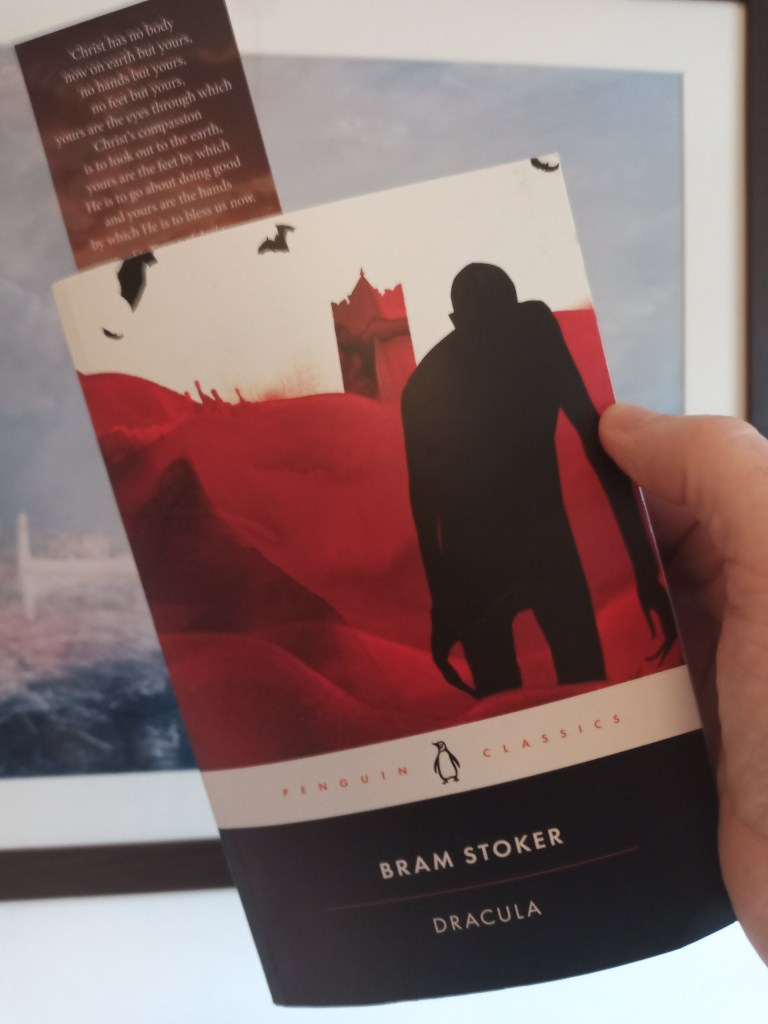
Whilst listening to a roundtable discussion of Exodus 90 men on Bishop Eric Varden’s ‘Desert Fathers in a Year’, one of the panelists suggested reading Bram Stokers ‘Dracula’ in the context of the sin of lust. As I was looking for some classic literature to read, I took up the challenge. I really enjoyed the novel in itself but was struck by the characters themselves, their beliefs and the ways they related to each other – in such deferential and courteous fashion – so very 19th century! It just struck me as being light years away from the world I was born into. The world I was born into told me that those Victorians were all sexually repressed and how much better our lives are today. Now today our conformity is to consumerism, self identity and expression, narcissism and hyper-individualism. Yes, in any society there is pressure to conform. Yes, many were just conforming without awareness in Bram Stoker’s time, but conforming to the Christian values of prudence, self-control and respect for the other. Yes, conforming without awareness is not ideal, but I would prefer a conformation to the sexual morality of Stoker’s times than that which we face today.
Lucy is one of the main characters of the novel, who is first attacked by Dracula in Whitby. She is eventually drained of blood, dies, and in turn becomes a vampire. A prominent feature of the early chapters of the book are the exchange of letters between her and her friend Mina. The exchange is focused on their romantic involvements…Lucy to Mina…’I forgot to tell you that Arthur is here. We have such walks and drives, and rides and rowing and tennis and fishing together; and I love him more than ever…’ (p.117. Penguin Classics 2003). The book editor Maurice Hindle tries to paint a picture of Victorian ‘repression’ by highlighting the following quote…’why can’t they let a girl marry three men, or as many as want her and save all this trouble. But this is heresy, I must not say it…’ (p.67) Hindle focuses on the “heresy” bit, implying that Lucy’s behaviour is stifled by rules. In actual fact, Lucy is merely expressing frustration at having to deal with proposals from three different but likable men, and has to finally admit to the final one that she is truly in love with someone else. Lucy is describing to her friend Mina the professions of love and affection from these various suitors…’…and then my dear, before I could say a word he began pouring out a torrent of love-making, laying out his very heart and soul at my feet.’ (p.66) It is interesting how language changes over time (not always for the good), ‘love-making’ would today be associated with the sex act whereas Lucy is using it in terms of the verbal expressions of love and affection. Whilst Hindle is critical of the excesses of modern critics such as Elaine Showalter (who equates the de-vampiring stake through the heart of the un-dead Lucy as a gang rape scene!p.xxiii) he firmly asserts that the repressed sexuality of Stoker is obvious. ‘To have identified sex as the monster that made Stoker write so anxiously must be a crucial first step in our understanding’ (Hindle.p.xxiv). He goes on to elaborate this idea to the point of alleging that the horror “thing” that Stoker is avoiding is the homosexual love he has for his employer – the actor, and owner of The Lyceum Theatre, Henry Irving. The problem with Hindle’s commentary, as I see it, is the notion of sex as neutral…that there is no real distinction between healthy and un-healthy (as in lust) sex.
‘With a mocking smile he placed one hand upon my shoulder and, holding me tight, bared my throat with the other, saying as he did so: “First, a little refreshment to reward my exertions. You may as well be quiet; it is not the first time, or the second, that your veins have appeased my thirst!” I was bewildered, and strangely enough, I did not want to hinder him. I suppose it is a part of the horrible curse that such is, when his touch is on his victim.’ (p.306) Mina explains this attack upon her, to her friends, in terms of a seduction that she is powerless to resist. Dracula taunts her with the proclamation that she will be his “wine press for a while” until she too will become a vampire and begin to feed on her friends. As in the vampiric act, sex as lust too sucks the life out of another, and of oneself. Like all addictions more and more of it is needed until we are dead – to love, seeing other people purely as objects of our own desire. Lust is a lonely place to be in, like the vampire searching for gratification at night and sleeping alone in his coffin during the daylight.
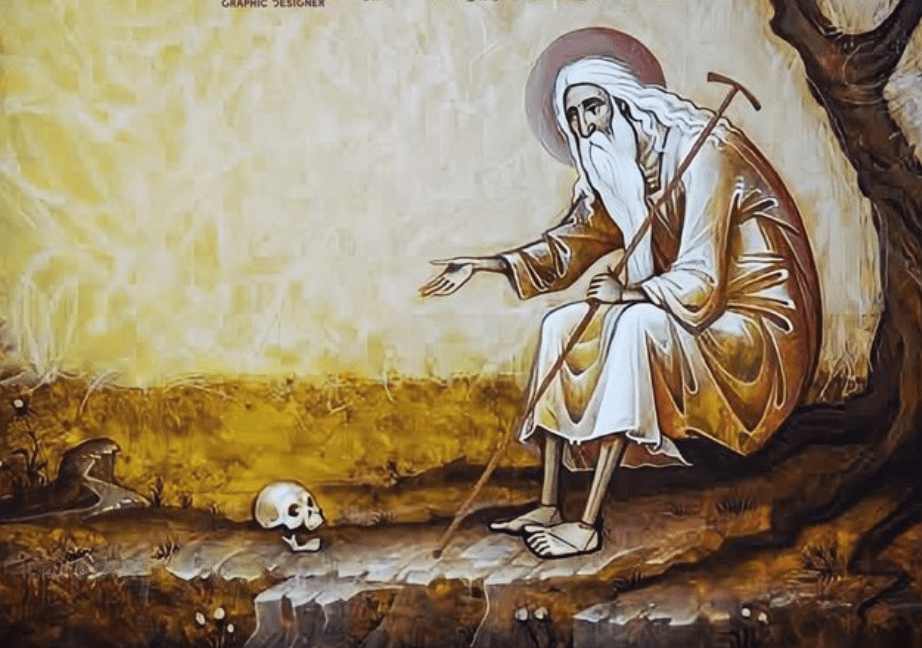
In his book ‘Chastity – Reconciliation of the Senses’, Erik Varden cites the story of the ‘Desert Father’ Abba Macarius who comes across a human skull in the desert. Macarius prays for the deceased person and the skull begins to talk to him describing the conditions in hell. ‘As far as heaven is from earth so far fire extends under our feet and under our head; when we stand in the middle of the fire, we cannot see each other face to face, for we are bound back to back. But when you pray for us, each of us can glimpse the face of the other.’ (Varden.Chastity.2023.p.143) In this vision of hell, the people there cannot see each other. They are denied the intimacy of really knowing another, the very thing that lust denies. Making the other only something useful to me in that moment.
Dracula’s thirst for blood is an analogy of the sometimes overpowering desire for sexual gratification. Controlling this desire is no easy task. Varden recounts the story of another ‘Desert Father’ Abba Zeno. After a long day in the desert and being very thirsty, Zeno comes across a field of cucumbers. An inner voice screams out to him, “go on, have a cucumber!” He reflects and asks himself the question, am I willing to face the outcome – the consequences of such a theft? He places the consequences before the act and takes up a position in the scorching sun as if placed in stocks. He gives up after five days not being able to stand it any longer – ‘therefore he said to his thought: “if you cannot bear the sanction you deserve, don’t steal and don’t eat.” ‘ (Varden.Chastity.2023.p.140) If he had taken the cucumber, Zeno may well not have been caught stealing, but the result would have been a spiritual death. As in the vampire’s hunger for blood and his satiation, the consequences are a slow death for the other and a firmly fixed state of static un-dead for himself. An eternal consequence of not ‘seeing’ the other – being stuck in the lonely place of a coffin.
Sexual desire can get mixed up in and with all sorts of unhealthy human behaviours and experiences. From living with and acting out past hurts to expressions of power play and the attractiveness of the dominance demonstrated by Dracula over his victims. Varden reflects on this conflict when discussing the characters from Harold Pinter’s play, Ashes to Ashes. ‘Human beings sometimes rationalize humiliation and hurt in terms of desire. It can seem a way of holding on to influence or agency in the midst of affective obliteration. When such recourse is channelled through physical instinct, it can present itself erotically, even though the realization of eros entails compulsive repetition of past pain. Two individuals can be locked in a mutually destructive dynamic: one acting out a claim to omnipotence; the other melting into compliance, fantastically construed as a state of being desired and valued.’ (Varden.Chastity.2023.p.94)
Our motto today is “Live to the full” . Or is this rather the quest to be full up, satiated on pleasure? Our utilitarian society demands usefulness. Make the most of other people, make good use of them while you can. Suck as much life out of life as you can then die and be no more than that pale figure in the coffin, a good or bad memory to those left alive…very vampiric!!
Well, returning to that snake in the grass, Malcolm McLaren, he died in 2010. It is the God of Mercy that he fortunately had to face for judgement, not me. I would offer him no plaudits and no mercy but throw him into the deepest, darkest dungeon where there will be wailing and gnashing of teeth; alone, for the sexual exploitation of a minor – if for nothing else. The sexual revolution has left many victims in its wake and McLaren was probably one of them. He was the victim of a broken family, neither his mother nor his father wanted him and he was raised by his grandmother – something no child should have to go through. As John Lydon sang – “no fun, it’s not funny.”
No fun, my babe no fun
No fun, my babe no fun
No fun to be alone
Walking by my self
No fun to be alone
In love with nobody else
(Sex Pistols 1976 – cover of a song by Iggy Pop And The Stooges)


 Brother Alberic