


I overheard a conversation recently on the appropriate way to refer to something we watch on the screen as being either a “movie” or a “film” (or as we say in Co. Kerry, a “fillum”). I had never really considered this before and felt that the two terms were interchangeable. For serious partakers of the genre this is patently not so. A ‘film’ is a serious business – it can refer to short-films, documentaries, independent films and old films. Its primary business is to provoke thought, offer information and provide education. It is a more technical term and its use is preferred by those in the industry. A modern feature film can be called a “film” but is more than likely called a “movie” with its primary focus on entertainment. A good film, as in feature film, will have all the elements to it. It will entertain as well as educate and promote reflection. But a film that you truly remember is the one that has an emotional impact on you…the “movie” literally “moves me.” Over the Christmas period I watched three movies as I had some free time and wanted a bit of entertainment. But being a Christian I felt it incumbent on me to chose films with some meaningful content. I was blessed in that all three movies did in fact move me in different ways.
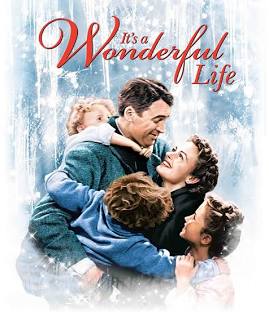
The first was an old ‘film’ from 1946 called ‘It’s a Wonderful Life.’ It looked familiar as I had probably seen it years ago but it had obviously not impacted me then. So many people have described it as the best film ever, so I had to revisit it. Loosely based on ‘A Christmas Carol’ by Charles Dickens, it is set in small town America. The main character is no Scrooge though, he is a young man with big dreams of changing the world. He wants to leave the small town to achieve his big dreams but circumstances dictate otherwise. He continuously and inadvertently gets drawn in to helping the less well off in the town to buy their own homes and not get drawn into the clutches of the Scrooge like property tycoon, Mr. Potter. When our hero George finds himself bankrupt he is tempted by suicide but an angel comes to his rescue. When George states that it would have been better if he had not been born at all the angel shows him what things would have been like if he had not existed. He is shown, in a Dickens ‘ghost of Christmas past and future’ type scenario, a town without George in it full of corruption and malice…called ‘Pottersville’! Brought back to reality he discovers his gratitude for all the people and places he is familiar with and loves. The story concludes with people calling to him with money that they have collected to keep him solvent. He realizes what he has and how much he is loved, especially by his wife Mary and their children. Yes even this cynical old fool shed a sentimental tear and realized why this was such a Christmas classic…I will definitely watch it again next year (along with the Sound of Music!).
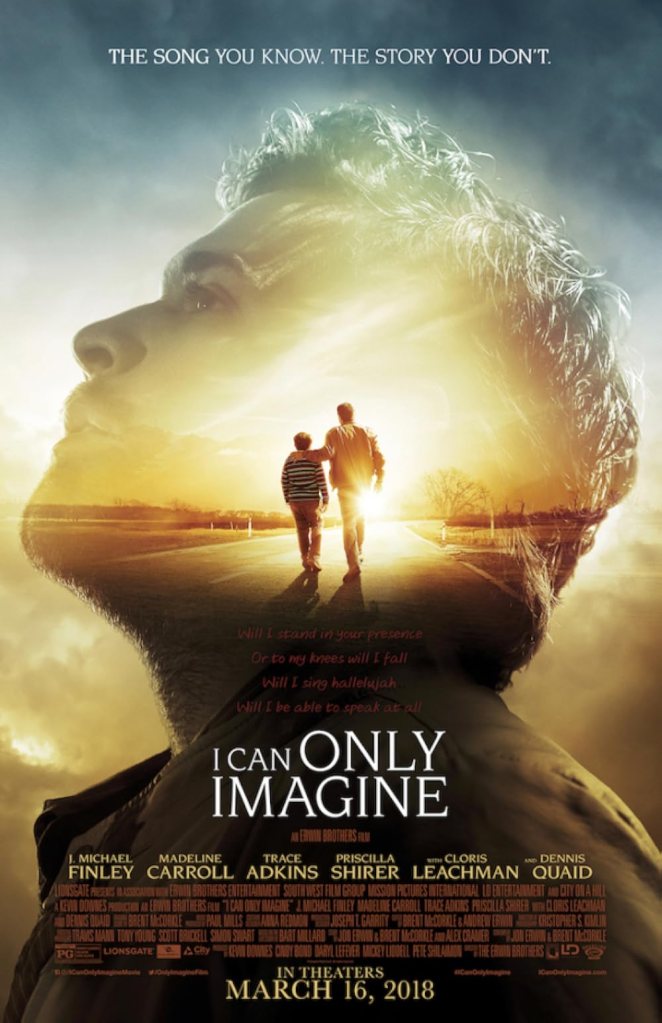
The next two movies watched were films based on the lives of real people. Number two movie was a move from the overtly sentimental to a more passionate tale. The biggest selling Christian record of all time is called ‘I Can Only Imagine’ by the band MercyMe. I had heard the song before and thought it ok but was not drawn to it or the band (I was into listening to the music of Rich Mullins at the time, whose songs did move me). I was a bit skeptical at first as it was free to view and an overtly Christian film. I was pleasantly surprised as Christian films had often disappointed over the years. It wasn’t the ‘low budget’ nature of these films that disappointed so much as the focus on preaching the message above subtlety of plot, character development and intrigue. ‘I Can Only Imagine’ follows the childhood angst of lead singer Bart Millard. As a 10 year old Bart’s mother walks out of the home leaving him with his abusive father. Bart plays football at college to please his father but then is unable continue because of breaking both of his ankles. He then discovers a talent for singing which his father mocks. Having some live success with his band, “MercyMe” they soon discover that record producers don’t think they are good enough to sign. Through the wisdom and paternal love of their manager, Bart is persuaded to go home and deal with his emotional difficulties. He confronts his father and is finally reconciled prior to his father dying. This leads to Bart writing the song ‘I Can Only Imagine’ which is then offered to the established star Amy Grant to record. She in turn gives it back to him telling him that it is his song to sing. Recorded by MercyMe it then becomes the biggest selling Christian single of all time and launches their career. As a back story to all this is the love affair with his childhood sweetheart Shannon. She wants to marry him as a ten year old and they date in college. His emotional problems and initial touring with the band meant that they split up. She is there in the audience for the first performance of ‘I Can Only Imagine’. At the end he sees her and leaves the stage fighting his way through the audience to get to her…they embrace and he says, “I’m sorry, I have always loved you,” to which Shannon replies, “I know”…cue reaching for the box of tissues! I found it quite an inspirational film and well worth the watch…and you can get it free on Rakuten.
My final Christmas movie was a whole different kettle of fish. Having wanted to watch it since its cinema release in September, it has been made available to stream for a fee from its own website. It is the story of one of my favourite saints Maximillian Kolbe and is called ‘Triumph of The Heart’. It tells the story of the martyrdom of Kolbe and his companions who were starved to death in the starvation cell of the Nazi concentration camp of Auschwitz after a prisoner had escaped. Not exactly a Christmas movie it was still powerfully emotive on many levels. When I first heard the story of Kolbe I was was struck by the eye witness accounts of how Kolbe would always be heard or seen praying with the others or singing songs of praise with them. The miracle was that they took two weeks to die and even then Kolbe and three others had to be finished off with injections of carbolic acid. Whilst this was represented in the film its creator, Anthony D’Ambrosio, wanted to show how Kolbe would have related on a human level with his fellow prisoners. The Nazis wanted to de-humanise their ten victims but Kolbe fought back to encourage his companions to own their humanity and dignity. He got them to introduce themselves by name and to continued using their names with each other. They were no longer a prison number. He got them to talk about their lives and families and even, ironically, to describe their favourite food. He was encouraging and passionately supportive when despair set in and manages to prevent one prisoner from trying to commit suicide. D’Ambrosio says that he developed his characters from a cross section of the different types of prisoner category at Auschwitz as the nine other prisoners with Kolbe were unknown. This made for interesting and effective dialogue but left the historian in me puzzled. Surely the man whose place Kolbe offered to take, Franciszek Gajowniczek, must have known some of the other men? (any insights on this please let me know). No tissue box needed for this one. It left me feeling stunned. It left me both in being aghast of the horrors mankind can commit and in the awe of how God responded to such a horror with a powerful love beyond human comprehension. And it tells us of how hope can be generated in the darkest of situations. I will definitely watch this one again sometime…maybe more appropriately during lent!
I hope you were moved by a movie this festive season.

 Brother Alberic