
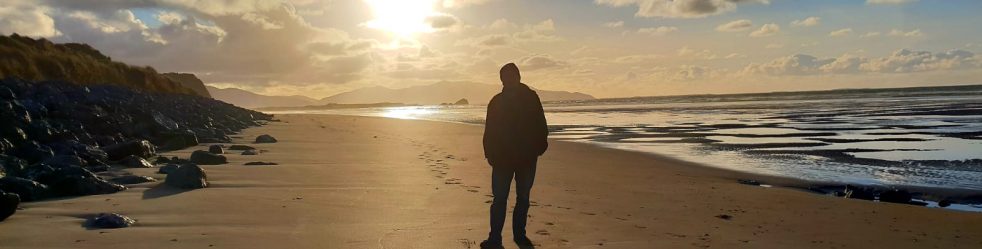
Introduction
The aim of this essay is to examine the following source texts – lyrics relating to the ocean and ocean voyaging – with regard to how they relate to the lives and experiences of the monks that wrote them and their communities. I will look at the ocean lyrics of Beccán mac Luigdech, The Voyage of Snédgus and Mac Riagla, The dialogue of Columcille and Cormac at Hy, Fegaid Uaib and The Seafarer. As most of this poetry relates to the monastic community of Iona, I will examine this community in relation to what we know of earlier settlements . This will refer to both Adomnan’s Vita Columbae and archaeological evidence. The essay will examine what was understood by a life lived in the desert in the early Irish Church and how this may have been influenced by early eastern monasticism. It will examine the evidence for voyaging and what we know of actual practices. I will relate the lyrics to tales of immrama, looking at the Voyage of the Uí Chorra and also to the influence of scripture. The essay will look at the desert as spiritual motif and how the lyrics attempt to interpret this in an insular context – the writers making use of their own environment to celebrate their life in both aspirational and actual terms, reflecting the omnipresent tension between the coenobitic and eremitical life.
..but there is an unpredictability of mood, the sea constantly changing, sometimes erupting
in crescendos of brute force destroying and remoulding the land and claiming human life. The
sea is a balance of opposites. It gives and takes. It can destroy land and quickly build anew; it
sustains life and it can kill.
Facing the Ocean – B. Cunliffe.
Approaching Skellig Michael on a not unusually dull windy day in Kerry, I was tossed about the boat with nothing to see but grey cloud. Suddenly the mount appeared as if from nowhere through the parting mist, majestically pointing to the heavens. Feelings of both trepidation and awe were present at once for me in my relatively safe 21st century environs. How much more so to a 6th century monk on pilgrimage, on his quest for an encounter with the eternal?
The sea was the ever present place which the early religious communities of Ireland related to in a way the monks of Egypt before them had related to the desert. A place both vast and terrifying yet awe inspiring and pointing to a sense of self abandonment that the monk had to achieve to reach God. How much of this journeying and abandoning of oneself on the sea was a reality for the monks of the 9th century, in a more established ecclesiastical climate? How much was this journeying a part of their lives and a cause for celebration? For the monks of Iona the ocean was a means of communication and a possible source of food – yet its harshness also represented a desert and they did indeed live, like the monks of St Catherine’s in Sinai, in the midst of this desert.
1) Thou hast merited satire and reproach
Beccn mac Luigdech, the author of early poetry from Iona, is identified by Clancy and Markus as being one of three characters or even possibly the same person. Beccán of Tech Conaill in Co. Wicklow, Beccán the Hermit – identified in the letter of Cummian to Ségéne, fifth abbot of Iona, in 632AD and Beccán of Rum. The island of Ruimm being as good as any in which to find ‘a desert in the ocean’ and whose situation would accord with the opening verse of Tiugraind Beccain [1].
The poem Fo Réir Choluimb is written both in praise of Beccán’s master, how he is bound unto him, and in a plea in confidence for the protection of the saint. In singing the praises of Columcille, and in exhorting others to praise him, he describes his journey from Ireland to Iona and his motivations, for ‘Godly Love’.
It was not on cushioned beds
he bent to his complex prayers:
he crucified – not for crimes –
his body on the grey waves [2].
Verse two sums up here the harshness of the environment in which Columcille operated. It is quite laudable, as far as Beccan is concerned, for his master’s prayers to emerge from an experience of harshness. That harshness being represented by the ‘grey’ ocean waves. Being amidst the ocean in this poem refers primarily to Columcille’s journey from Ireland in penitential mode, ‘boldly over the sea’s ridge’, because of entering a pact (verse12). Verse 13 brings out the typical desert theme of mortification – ‘battling the flesh’ in very much the manner of Jesus’ forty days in the wilderness. It extols his knowledge and learning yet points to his need for the basic skills of seamanship:
He stitched, he hoisted sail tops.
Not, as other texts might suggest, was his penance of sea journeying a matter of complete submission to the elements and providence – this verse gives the impression of a determined and experienced sea traveller who was intent on going somewhere, thereby celebrating a voyage of known purpose and intent. The ‘desert’ here presents a challenge to the saint. Whilst his own will and determination is evident in verse 13, verse 14 tempers this with a reliance on God’s providence:
prosperous, numerous, safely,
a storm blew them in boats over the brine
The storm here is an agent of safety not danger because of the saint and his companion’s trust in God.
The sea as ‘desert’ points to our inadequacies and vulnerability. Brave is the person who exposes himself to this hardness, exclaims verse 15, ‘though they were lame they had strength’. Through trust in divine providence the weaknesses exposed by such a force as the ocean are transformed into strength – echoing the scriptures of St.Paul’s power through suffering motif (2 Corinthians 12:9). Another key in this poem to link it to a celebration of desert/eremetical spirituality is verse 19 whereby he is both pictured as confronting this harshness and solitude with a ‘blessed band’ yet still requires to draw further into solitude:
he often spent nights withdrawn;
silence, too, thinness of side..
The second poem of Beccán, Tiugraind Beccain… the last verses of Beccán to Columcille, suggest that they were composed towards the end of the life of this possible hermit and devotee of Columcille. As in the previous poem a strong theme that emerges is that of willingly embracing exile for the love of God. He embraces a journey across the ‘long haired sea’, the sea crossing being a means of finding a particular desert place that may be amidst the sea but is not the sea itself. Verse 5 is in honour of that ocean which carried him
wave-strewn wild region, foam-flecked, sea filled, savage, bounding,
seething, white-tipped, pleasing, doleful.
It seems strange that something can be both seething and dreary yet pleasing as well. Pleasing possibly because the journey itself was part of the exile/desert experience that was necessary to draw closer to God. The journeys end, Iona, remains in this form of discomfort and hardship – ‘within church ramparts’(vs.23) he works for God and ‘lived against a stringent rock’, giving up bedding to ‘embrace stone slabs’, whilst he sleeps little (vs.15-17). Giving up claims of kinship and wars for the love of learning he left chariots and ‘loved ships’(vs.18&19). It is interesting that ships are not seen as compatible with the ‘kinship’ and ‘strongholds’ of his former life, possibly highlighting the acute danger and risks involved with seafaring in the 7th century.
2) Searching the Islands
The Voyage of Snédgus and Mac Riagla, told in prose form as well as poetic, tells the story of the Men of Ross persecuted by a wicked King Fiacha whose brother Donnchad seeks to punish them after Fiacha is murdered. He seeks the aid of Columcille whose disciples Snédgus and Mac Riagla recommend that they be set upon the sea without oars or sail to drift and not return, allowing God to pass judgement upon them.
On their return to Iona Snédgus and Mac Riagla head out into the open sea intending to go on pilgrimage, as the men of Ross had done but of their own volition. After the biblical three days had passed they could endure it no longer, a ‘father why have you forsaken me’ episode when God takes pity on them leading them to a stream. At this they put their full trust in God and ship the oars. A Brendan like tour of eight further Islands follows. On the biblically complete island number seven they again meet up with the Men of Ross who have now repented and live with the prophets. The eighth Island to be visited is the perfect ‘delightfully and hallowed’ place, where there is an altar at every door. As in the Brendan voyage they are not permitted to stay and are requested to return to Ireland and warn the people of a coming vengeance to be visited upon them.
The overriding theme of this voyage – to find a desert in the ocean, is one of journeying and return. The already renounciate monks from Iona seek further solitude only to be told to return and share what they have learnt.
Snédgus and Mac Riagla are portrayed as travelling on ‘the angry sea’ and that it is on the islands above the ‘fearsome ocean’ that they encounter great mysteries[3] . The ocean is a place of danger to be overcome – it is the island that becomes the place of discovery. Even then it is not a place to dwell in, journeying/pilgrimage is celebrated rather than the arrival in any definitive place.
The fourth place to be visited is the island of the great tree with beautiful birds who in the poetic version sing ‘chants- a joy to the heart…’. The lead bird preaches the ‘noble mystery’ of the intentions of God before creation. The birds beat their wings when bad tidings are proclaimed and ‘the roar of the sea storming’ is significantly linked to the proclamation of Christ’s crucifixion which in turn is aligned with the final judgement [4]. The ocean voyage in this sense becomes a search for God’s judgement.
3) Cormac’s search for a desert
Cormac, one of the most well travelled persons associated with Iona and the community of Columcille, was in the words of Adomnan’s Vita Columbae
a truly pious man, who not less than three times went in search of a desert in the ocean,
but did not find it [5].
His third journey recounted in the V.C., which finds him being rescued from ‘a multitude of loathsome and annoying insects’ by the prayers of Columcille and his community, sees the inevitable return of Cormac so that he may once again be ‘face to face’ with Columcille in the ‘extreme joy and wonder of all’ [6].
The ‘face to face’ Dialogue of Columcille and Cormac in Hy, after Cormac has ‘searched the boundless ocean’, sees Columcille gently rebuke the monk for his nautical wanderings pointing to his return to Ireland for ‘It is in Durrow thy resurrection shall be’ [7]. The text sees Cormac delighting in his journeying if indeed his final destination shall see a return to Ireland (vs.6). The whole tenure of the verse is that the voyaging is part of a state of exile, even the possible place of a ‘desert in the ocean’ which Columcille himself may have found at Iona, is merely a temporary place of penitence and mission to unbelievers, rather than a place of settlement in itself and for its own sake. This comes over clearly in vs.8 when Columcille proclaims that ‘Death is better in reproachless Erin, than perpetual life in Alba’ [8]. Cormac’s pilgrimage from Ireland is welcomed by Columcille whose memories of return to the homeland are both lamented and described as a source of inspiration. The desert is here celebrated as part of a journey in search of both God’s will and the final place of one’s death and resurrection.
4) The Sea as the place of encounter with God?
Fegaid Uaib – ‘The Sea’, belonging to a collection of possible ninth century works popularly known as Irish ‘Hermit Poetry’, points to the ocean as being something worthy in itself. It begins with a call to contemplation, to ‘look you out north-eastwards over mighty ocean’ possibly the start of the journey made by Columcille and many others (traders included) from Ulster to the Dal Riata area of what is now Scotland. It is an ocean ‘teeming with sea-life’ which is ‘splendid’. That ‘It’s tide has reached fullness’ [9] could be seen in allegorical terms of both the subject as drawing spiritual fullness from a contemplation of the ocean, and a call to start ones journey upon the high tide. As this poem remains without context it is difficult to draw any certain conclusions from it. It contrasts with the previously cited poems in its positive view of the ocean yet it remains the only poem to deal with the sea or voyaging in the whole corpus of 14 poems. Doubt is also cast on the historical validity of the poems as a whole by such scholars as Donnchadh Ó Corráin [10].
Another famous poem entitled ‘I am wind on sea’, which dates from at earliest the tenth century, sees the poet claiming kinship with the wind and the waves, the animals, lakes and mountains. Claimed as the expression of a mythological figure, it is difficult to know how much this was reflected in the thinking of tenth century monks and whether it refers to divine utterance or some form of mystical absorption. However this type of poetry is rare and cannot be situated historically to really be a determinant of early insular monastic spirituality [11].
5) The Seafarer – an Anglo-Saxon perspective
The Seafarer presents the ocean itself as a place of exile. The ocean itself is gloried in as a place of redemptive suffering. The first half of the poem contrasts the safety of the ‘land lubber’ with the dark dangers of seafaring.
That man lolling on fair land
has no earthly inkling of how I
a wretched wreck on ice-cold seas
weathered each winter
exiled from kith and kin [12].
The person on land has no real idea of what it is like. ‘The load I hauled along sea-lanes’, might suggest that our subject is a trader, although the second half of the poem is overtly religious. This could signify a combination of two poems. ‘Longing with lust to roam rough seas alone, to seek out some far foreign shore’, could place our subject in line with the peregrinus who is looking for somewhere specific to go, or it could reinforce his desire to extend his trading routes!
The seafarer ‘wants no worldly joys, only the rolling oceans urge him on, the wave play pulls him and impels’. His whole life is seen in relation to the sea itself – ‘my mind is cast upon the sea swell’ – the sea is offering some form of self discovery which in turn leads to discovery of God. ‘God’s visions are to me more vivid than this dead life loaned out on land’ [12]. The poem then turns its emphasis towards the general virtue of a dependency on God, away from the hardships of a solitary sailor.
Colin A. Ireland supports the view of interpreting the seafarer in terms of a perigrinus. This idea, first proposed by Dorothy Whitelock, is based on historical evidence to suggest contact between Irish perigrini and the Anglo-Saxon ecclesiastical community [13]. In his paper on The Manuscript Context, Corey Owen supports a view of the poem as allegory regarding spiritual crisis and encouragement for 10th century Anglo-Saxon Monks. Such rejoinders as ‘a man should steer a steadfast course, be constant, clean and just in judgement’, at the end of the poem would tend to support this view. He cites both Frederick Holton and Dee Dyas in presenting the sea journey as a metaphor for life, its significance relying on its contrast with a life lived on land [14]. Whilst Colin Ireland accepts that a variety of possible interpretations are based on a clear lack of a definite frame of reference for the poem, he cannot bare to look at it in terms of mere allegory. What could be seen as bed time reading for monks would not be acceptable to a peregrinus – a man of action, set on satisfying God’s command to take a message to others [15].
6) Where does the desert motif come from?
Prepare in the desert a way for Yahweh,
Make a straight highway for our God across the wastelands
……then the glory of Yahweh will be revealed
and all humanity will see it together.’ (Isaiah 40:3-5, NJB)
A life lived in the desert features strongly in early Christian tradition. Biblically it appears to be a place of preparation where God’s will can be know and then, significantly, shared with others. The idea emerges from the Israelite wanderings of forty years. The Torah given during this time is then taken to the promised land. Jesus’ forty day imitation of this precedes his teaching ministry – both episodes are full of trial, temptation and discovery [16].
Christian monasticism can be traced back to the Desert Fathers. These communities that developed in the fourth century are popularly seen as a reaction to the institutionalisation of Christianity after Constantine’s conversion. Although there are other more sophisticated explanations for its development [17], monasticism does appear to have developed as a new type of Christian practice that has run parallel to the mainstream church ever since its inception. Whilst Biblically the desert is presented as a transient phenomena, the desert fathers presented a way of life that had a sense of permanence to it, albeit one of exile. The desert experience still maintained those elements of trial, temptation, discovery and teaching for the residents of the fourth century Egyptian desert.
In Ireland, the evidence is sparse for a definitive type of Christian organisation and practice from the fifth to seventh centuries. From the seventh century on we can see the establishment of large and settled monastic communities, along trade and communication routes like Clonmacnoise, and at the forefront of ecclesiastical organisation. This therefore contrasts with the earlier settlements which were a lot smaller and in more remote places. There are nine small monastic settlements located on off-shore islands about the Dingle and Iveragh peninsula’s in Co. Kerry, Ireland. One of the smallest , Illaunloughan, perches on 0.1 hectares of land and was probably home to a community of no more than three monks [18]. This desire to live and practice one’s spirituality in remote, isolated places does parallel some of the practices of the early desert fathers.
It is not clear if the monks of these communities saw themselves as hermits living in some form of undefined association or if they had any of the more formal structures of a coenobitic community under the authority of an abbot. It is possible that the larger monastic settlements of the seventh and eighth centuries did develop structures based on the monasticism to emerge from the Egyptian deserts and that some of these verses were in some sense based on nostalgia.
The early communities of Egypt were coenobitic in structure and the life of an anchorite was something that had to be aspired to [19]. In the early communities the emphasis appears to be on relationships and the lack of a clear distinction between coenobitic and anchoritic lifestyles. They were probably interchangeable to suit the needs of the monk as he developed under the guidance of his Abba [20]. From the writings of John Cassian and a later monastic tradition we see a more developmental view of early monasticism. His view of the Egyptian communities saw them as essentially coenobitic at first until the time of the first hermits Anthony and Paul and then developed to ‘allow’ the anchorite life only to those who had become ‘perfect’ in the coenobitic life [21]. Cassian also criticises those he calls sarabaites for attempting to live the eremitic life without the authority of an abbot to guide them [22].
How much of this was mirrored in early Irish monastic practice is not at all clear. We know next to nothing of the practices let alone theology of those early island hermits. We can see from later monastic practice that the role of the anchorite was lived in relation to the settled community and only undertaken very rarely when they were ready for it. We can see this in Adomnan’s Vita Columbae when Cormac’s first voyage fails because he is accompanied by a fellow monk who had not got the permission of his abbot to be there (V.C.i-6). Colman Etchingham in his analysis of the Canones Hibernenses and other source text points to the rarity of eremitic practice and also that those permitted to live as anchorites were accorded, ‘the very highest rank, setting him on par with the bishop and king’ [23]. From this later monastic period – ‘the unregulated or self appointed solitary holy man was viewed unfavourably, whilst at the same time the authorised anchorite was highly regarded’ [24].
How much were the early monks on the islands off the south-west coast of Ireland ‘unregulated and self appointed’? Were the monks of the eighth century so regulated that their writings reflected a yearning for the golden age of a lost eremitical life? Or did it reflect aspiration to a higher form of practice that was highly regarded?
Even the desert fathers are scrutinised for evidence of this. The view of Philip Rousseau that the desert communities underwent this type of chronological development is refuted by Graham Gould in his analysis of Anthony the hermit, that he was committed to both solitude and the community life and not to an
earlier more isolated form of monastic life that was superseded when numbers grew,
wandering in the desert became less common, and communities became more stable [25].
It is easy to see chronological development when we view a more primitive form of practice with very little evidence to go on. I suspect that the monks on Illaunloughan may have experienced conflicts about eremitical or community life in much the same way that the monks on Iona did. The poetry we are examining does not point to an historical chronology but to a way of life with its many expressions being celebrated.
7) Peregrinatio – why were the monks voyaging?
Being cast upon the waves may have developed from pre-Christian punishments for minor offences and for the children of incest according to Clancy, although Byrne sees it as a softer punishment meted out by clerics in response to the harsh and deadly punishments of the pre-Christian era [26]. It was a punishment for Kin-slaying enacted by Adomnan’s law protecting women, children and clerics from violence in 697AD [27]. We can see by the Voyage of Snédgus and Mac Riagla that it was used for the punishment of the sixty couples of the Men of Ross for the murder of King Fiacha.
Whilst there is evidence for its practice as a secular punishment for criminals, evidence points to it being taken on by the church as its own form of punishment for grave sin and as a means to determine difficult judgements in relation to judgement and penance. Early Church practice of a public ‘once only’ penance for sin would have been severe and often involved long exiles. By the seventh century this had begun to change with the emergence of the Irish penitentials which turned to a more hierarchical and private form of penance to solve the problem of repeated sin in the church [28]. Whilst monks would have been more traditional and orthodox practitioners of church discipline they may have seen the setting adrift option as one which would be both permanently penitential and a way of, in a sense, ‘divining’ God’s will. The peculiarly Irish nature of this practice is demonstrated by the three monks that turn up in King Alfred’s court after having set themselves adrift, as recorded in the Anglo-Saxon Chronicles [29].
As the penitentials have demonstrated, exile appears as a primary source of penance [28]. Leaving one’s home and going abroad is taken up by the religious and what may have started out as punishment for sin becomes an opportunity to evangelise. Adomnan tells us that Columcille sets sail away from Ireland two years after the battle of Cul Drebene [30]. A popular but unsubstantiated belief that his involvement with this battle led to a public penance is widely held. Adomnan does inform us that he was wrongly excommunicated by the council of Teltown [31], so although there was no ostracism, it is probable that his exile in Scotland was as a result of a penance. That it was of the setting adrift variety is unlikely as the route taken was one not unknown but well travelled [32].
Though it is debatable how much this voyaging was undertaken as a result of an imposed penance of exile or as the simple desire to go on pilgrimage for Christ’s sake, it still appears a popular thing to do for monks of the early Irish church. The ocean was therefore a means by which they could both evangelise to unbelievers and seek their place of resurrection. These ‘continental peregrini’ may not have had solitude as their aim and whether Columbanus or Fursey saw their mission in terms of a ‘desert’ experience is hard to determine. Their voyaging though did have something to contribute to the literature that related the sea to spiritual development and understanding –
For knowledge of the Trinity is properly likened to the depths of the sea, according to that
saying of the sage, ‘and the great deep, who shall find it out?’ If then man wishes to know the
deepest ocean of divine understanding, let him first if he is able scan that visible sea…’
(Sancti Columbani 64-5)
From the Apgitir Chrabaid [33] to the introduction of the Stowe Missal, the liturgical and theological themes of Christianity have often been related to the sea in early Irish literature therefore the poems are not written in isolation in this respect.
8) The Uí Chorra – Storytelling as a celebration of the Christian life
The Voyage of Snédgus and Mac Reagla belongs to the genre of Immrama. These ‘voyage tales’ around islands are often tales of repentance undertaken in response to specific crimes. The three Ui Chorra are turned away from their deed of sacking churches and monasteries (an historically topical crime that the church had to address) and voluntarily go on the voyage after their penance of restoring the churches had already been completed. They go not as a penance, but to extend their knowledge of God. Most of the sights seen are either sinners punished amid the ocean waves or of ‘happy hermits’ [34]. In these tales we are presented with pictures of heaven and hell, of men with dogs heads – all the aggression and oppression of early mediaeval Irish society placed on ‘desert’ islands. If we can face these deserts, the authors appear to be telling us, in the light of Gods revelation we can find salvation.
Over the gravel of the mighty roaring sea
For knowledge of the wonderful folk…..
we went on pilgrimage at the blast of the whistling wind.
To obtain forgiveness of our sins.
(Voyage of the Ui Chorra 77)
There may be an element of pre-Christian story telling here even if it is difficult to extract the Christian from its pagan themes. The idea of encounter with an ‘otherworld’ is prevalent. Storytelling is both a means to entertain and inform. The readers of the Immrama were invited on an imaginary journey to desert islands to encounter fellow strugglers trying to find meaning and to live some of the Christian precepts that are obviously trying to be taught, even if they are for our age a little strangely harsh- like the punishments for breaking the Sabbath (Uí Chorra vs.61-63). Storytelling in this era was a communal activity and may therefore have been seen in terms of celebration.
9) Iona – the backdrop to a writing environment
Although we have very little evidence of what life was like in the earliest Irish monasteries we can build up a substantial picture of what life was like on Iona, if not at its inception but at the end of the 7th century. Adomnan give us a picture of Iona from the V.C. that probably reflects his own times rather than that of Columcille and the writings would have come from this and later periods.
Most of the buildings on Iona would have been made from wood. Adomnan tells us that oak and pine trees were being brought to Iona for a great house and on another occasion for repairs to the monastery (V.C.ii-45). The building of a guesthouse made of wattle is mentioned (V.C. ii-3). There have been a number of postholes excavated, the clearest feature suggesting a roundhouse concurrent with early monastic settlements [35].
On the western side of the monastic site exists a earth bank which may have been there before and used as the basis for a walled vallum. As the remainder of the wall cannot now be found it has been suggested that this was deliberate to suggest that the whole Island is seen as sacred space [36]. Most monasteries of the period used ditches for vallum and an inner ditch has been discovered to suggest that a double enclosure existed [37]. Double and triple enclosures were a common occurrence at this time which suggests a need to create a more contemplative area away from the work of the monastery and its visitors.
The work of the monastery appears to have consisted of cereal growing and there is evidence of a water mill in operation around this time [38]. Some of the fish bones excavated indicate that the monks would have had to have engaged in offshore fishing to facilitate this. There is archaeological evidence for metal working which is reinforced by Adomnan in V.C. ii-29 referring to monks who ‘knew the blacksmiths trade’. Excavations have also indicated the existence of glass working and a woodturning workshop [39].
From the amount of written texts that we now have that came originally from the Columban Familia we can assume that there was a thriving scriptorium. What presents is a late seventh century monastery that is a very busy large organisation, a corporate spiritual factory very distant from the simplicity of a remote hermitage. Much of the poetry we have examined can be traced back little before the 9th century so how much more complex would the workings of the monastery have been then? The poetry comes from the milieu of a developed coenobitic life, much valued and as a result much celebrated. With all this bustling activity, it is not surprising that individuals like Cormac wanted to find a desert in the ocean in which to fight his demons – away from the distractions of the monastery. It is interesting that in V.C. i-6 the object of his search is described as herimum in oceano – that a hermitage was in fact what he was looking for [40].
Yet the Iona community saw itself as deserted in relation to the rest of the church in that it was positioned at the very edges of the known world. The prophecy of Acts 1:8 that the gospel would be preached to the ends of the earth must have found a resonance in Iona [41]. The perception that this prophecy was being fulfilled had its origins in the work of Patrick and must have pervaded much of the early Irish Church’s theological thinking.
This might have led to some collective experience of desert for the community as a whole despite the need of certain individuals within it to find a further ‘desert in the ocean’.
Conclusion
Some evidence of the ocean being a place of divine contemplation does occur in the later poems of Fegaid Uaib and ‘I am Wind on Sea’, although the genre of ‘hermit’ poetry extolling the virtues of the eremitical life and being ‘all alone in my little cell’ has had doubt cast on its historical validity [42]. The Seafarer celebrates a life lived at sea, and whilst may have been strongly influenced by Irish Immrama, probably gives us more of a flavour of Anglo- Saxon seafaring tendencies than informing us on the lives of early Irish monks.
The ocean remains in the case of the Immrama and Iona poems, and in accordance with biblical themes, – the ‘abyss’, the place of sea monsters and evil. In the analysis of Borsje the sea, and the monsters therein, are presented as non-moral evil a place in which to discover moral evil (disobedience, disbelief etc.) and moral good (belief, trust) [43]. The ocean being therefore a place, and more importantly a symbol, for moral and spiritual discovery.
The desert itself presents as an ambivalent symbol [44], but one which in the earliest Christian traditions represented a radical quest for God. Rather than emphasising desert and ocean as symbols of mystical absorption I have tried to look at what else lay behind the quest of early Irish monks for ‘a desert in the ocean’, and how this was indeed celebrated by the writers of early Celtic lyrics.
It is clear from the stories of Columcille and Cormac that the desert being sort is an island hermitage safe from the abyss of the ocean, yet surrounded by it. The Voyage of Snedgus and Mac Reagla sees the clerics being fed at each island like the manna given to the Israelites in the desert. It clearly is a celebration of the search for a desert but not necessarily of life lived in one. The subjects of the poems are either on pilgrimage or in exile from which they hope to return. If the desert is found it rarely describes what goes on there – compared with the complex interrelationships of the early Egyptian communities.
There is a restlessness associated with Insular spirituality as compared with the relatively more settled existence of the Desert Fathers. Maybe this is the natural restlessness bound up with being an island and seafaring people. This may also open up further questions, beyond the scope of this essay, on how climate can dictate the temperament of a people.
In conclusion I think that the poems were probably both a celebration of the renounciate lives of the writers, lived in a more developed monastic setting, and of the hope for a more solitary and deeper experience of God.
Notes
1] Clancy & Markus 1995 Earliest Poetry of a Celtic Monastery p.132-133
2] Clancy & Markus 1995 p.137
3] Immram Snédgus vs. 2-3
4] Immram Snédgus vs. 28
5] Vita Columbae Book 1 Chapter 6
6] Vita Columbae Book 2 Chapter 42
7] The Dialogue of
Columcille and Cormac vs. 5
8] The Dialogue of
Columcille and Cormac vs. 7
9] Fegaid Uaib Carney (ed.)
10] Ó Corráin 1989 p. 256 ‘it will be evident that there is no evidence, textual or
contextual, to link these pieces to any movement, anchoritic or
otherwise. In short, the date of these poems is far too uncertain
to attach them to the ascetic movement of the late eighth and
early ninth centuries.’
11] Low 2002 ‘The Natural World in Early Irish Christianity’ p.188
12] The Seafarer Charles Harrison Wallace (trans.)
13] Ireland C. 2000 ‘Some Analogues of the Old English Seafarer’ p.156
14] Owen C. ‘The Manuscript Context’.
15] Ireland C. 2000 ‘Some Analogues….’ p.156 ‘Although the poem is susceptible
to an allegorical interpretation, the exploits of the early
seafaring peregrini transcended mere allegory. Allegory is for
sedentary thinkers. The Peregrini were men of action. They
were willing to leave their homes in order to follow the
examples, first of Abraham…and second of the Apostles, to
spread the gospel.’
16] The gospel accounts of Matthew and Luke attest to his battle
with the devil. Mt. Chpt. 4 & Lk. 4:1-13.
17] Gould G. 1993 p.2-3. E.R. Dodds sees the movement as an ascetic reaction to
an age of anxiety whilst P. Brown sees it as a response to
hardship and the resurgence of Coptic nationalism.
18] White Marshall, J ‘Illaunloughan, Co. Kerry: An Island Hermitage’.
& Walsh, C.
19] Gould G. 1993 p.29. ‘A certain brother having withdrawn from the world and
taken the habit, immediately shut himself up, saying, ‘I’m an
anchorite.’ When the old men heard they came and threw him
out of his cell, and made him go round to the cells of his
brothers, doing penance and saying, ‘Forgive me for I am not
an anchorite but a beginner.’’ Apophthegmata Patrum 243
20] Gould G. 1993 The Desert Fathers on Monastic Community. p.140
21] Cassian Conferences 18 – 4 . ‘The second is that of the anchorites who were first
trained in the coenobium and then being made perfect in the
practical life, chose the recesses of the desert , and in this order
we also hope to gain a place.’ (My emphasis).
22] Cassian Conferences 18 – 7
23] Etchingham, C. 1999 ‘Monasticism in its Primary Sense’ p.329
24] Etchingham, C. 1999 p.361
25] Gould, C. 1993 p.155
26] Byrne, M.E. 2000 ‘On The Punishment of Sending Adrift’. P.24.
27] Clancy, T.O. 2000 ‘Subversion at Sea…..’ p.200.
28] Bieler, L. (ed.) 1975 The Irish Penitentials p.272.
29] Anglo-Saxon Chronicles A.D. 891 ‘And three Scots came to King Alfred in a boat
without any oars from Ireland; whence they stole away,
because they would live in a state of pilgrimage, for the
love of God, they recked not where. The boat in which they
came was made of two hides and a half; and they took with
them provision for seven nights; and within seven nights they
came to land in Cornwall, and soon after went to King Alfred.’
30] V.C. i – 7.
31] V.C. iii – 3.
32] Sharpe, R. Introduction to V.C. p16.
33] Clancy T.O. 2000 p. 206. ‘the sea voyage has acted then almost as a second
baptism: no accident perhaps, if we consider the retailing of
the meaning of water in salvation history at the Easter vigil, for
instance. Indeed a popular Irish religious work discusses the
‘three waves’ which pass over a person in baptism, and how
these convert a person from being a ‘son of death’… to being a
‘son of life.’’
34] Clancy, T.O. 2000 p.211.
35] McCormick, F. 1997 ‘Iona : the Archaeology of the Early Monastery’ p.52.
36] McCormick, F. 1997 p. 68.
37] McCormick, F. 1997 p. 49.
38] McCormick, F. 1997 p. 55.
39] McCormick, F. 1997 p. 60 & 61.
40] O’Loughlin, T. 1997 ‘Living in the Ocean’ p. 22.
41] O’Loughlin, T. 1997 p. 19.
42] Murphy G. 1998 Early Irish Lyrics
another example of this genre sees the eremitical life in a sense idealised-
p.19 ‘All alone in my little cell, without a single human being along with me: such a pilgrimage would be dear to my heart before going to meet death. A hidden secluded little hut for forgiveness of all evil; a conscience unperverted and untroubled directed towards holy Heaven.’
Ó Corráin takes issue with the translation of the word ailethrán as ‘pilgrimage’ preferring to use the word ‘retire’ to support his argument that this is not real desire for the real eremitic life –
‘What the poet envisages is neither a hermit nor an anchorite nor a wild holy man of the woods, but a perfectly normal high-ranking clerical retiree of the period – so normal indeed that this poem can be read as prescriptive verse rather than as descriptive personal lyric…’(Ó Corráin 1989, 261-2)
43] Borjse, J. 1996 From Chaos to Enemy p.165.
44] McGinn, B. 1997 ‘Ocean and Desert as Symbols of Mystical Absorption…’
p.156-7
George Williams in his ‘Wilderness and Paradise in Christian Thought’, identifies at least four motifs, both positive and negative, that later Christians drew from the desert themes of the Hebrew Bible: ‘a) the wilderness as moral waste but a potential paradise; b) the wilderness as a place of testing or even punishment; c)the wilderness as the experience or occasion of nuptial (covenantal) bliss; and d) the wilderness as a place of refuge (protection) or contemplation (renewal). Particularly important .…are those text (e.g. Jer.2:2; Hos.2:14; Song 8:5) that speak of the desert as the place of betrothal either between God and Israel or, by extension, between God and the human person’.
Bibliography
Source Texts
V.C. Vita Columbae – Adomnan of Iona. Translated by Richard
Sharpe. 1995. Harmondsworth. Penguin Classics.
F.R. Fo Reir Choluimb
T.B. Tiugraind Beccain – from ‘The Poems of Beccán mac
Luigdech’ in Iona: The Earliest Poetry of a Celtic Monastery.
T.O. Clancy & G. Markus. 1995. Edinburgh.
I.S. Immram Snédgus ocus Meic Riagla – poetry version translated by
Donncha O’hAodha. Celtic e-library, Lampeter.
http://www.lamp.ac.uk/celtic/DesertLib.htm
V.S.R. The Voyage of Snédgus and Mac Riagla – prose version translated
by Whitley Stokes. Celtic e-library, Lampeter.
D.C.C. The Dialogue of Columcille and Cormac in Hy – Translated by
Eugene O’Curry. Life of St. Columba . W. Reeves
Celtic e-library. Lampeter.
V.U.C. The Voyage of the Ui Chorra – translated by Whitley Stokes.
Celtic e-library. Lampeter.
S.F. The Seafarer – translated by Charles Harrison Wallace.
Charles Harrison Wallace’s Seafarer Page
http://212.67.202.29/~cichw/index.htm
F.U. Fegaid Uaib – translated by James Carney.
Medieval Irish Lyrics. 1967. Dublin : Dolmen Press
C.C. The Conferences of John Cassian. Translated by
Edgar C.S. Gibson
The Benedictine Web Site.
http://www.osb.org/lectio/cassian/conf/index.html
V.A. Vita Antonii – Athanasius.
Nicene & Post Nicene Fathers Series
Celtic e-library, Lampeter.
V.CI. Vita Columbani – Jonas of Bobbio. Translated by
D.C. Munro. Paul Halsall’s Medieval Source Book.
http://www.fordham.edu/halsall
A.S.C. Anglo-Saxon Chronicles –
Part 2 A.D. 750-919. The OnLine Medieval & Classical Library.
1996. http://www.sunsite.berkeley.edu
Bieler, L (ed.) 1975 The Irish Penitentials
Dublin.
Borsje, J 1996 From Chaos to Enemy : Encounters with Monsters in Early
Irish Texts.
Instrumenta Patristica 29. Turnhout.
Byrne, M.E. 2000 ‘On the Punishment of Sending Adrift.’ The Otherworld Voyage
In Early Irish Literature, J. Wooding (ed.)
Dublin: Four Courts Press.
Clancy, T.O. 2000 ‘Subversion at Sea: Structure, Style and Intent in the Immrama.’
The Otherworld Voyage in Early Irish Literature,
J. Wooding (ed.) Dublin : Four Courts Press.
Ó Corráin, D. 1989 ‘Early Irish Hermit Poetry?’ Ó Corráin et al (eds.) Sages, Saints,
And Storytellers Celtic Studies in honour of Prof. James Carney.
Maynooth.
Cunliffe, B. 2000 Facing the Ocean
Oxford.
Etchingham, C. 1999 ‘Monasticism in its Primary Sense.’ Church Organisation in
Ireland AD 650-1000.
Maynooth.
Gould, G. 1993 The Desert Fathers on Monastic Community.
Oxford : Clarendon Press
Ireland, C.A. 2000 ‘Some Analogues of the Old English Seafarer from
Hiberno-Latin Sources.’ The Otherworld Voyage in Early
Irish Literature, J. Wooding (ed.) Dublin: Four Courts Press.
Low, M. 2002 ‘The Natural World in Early Irish Christianity: an ecological
Footnote.’ Celts and Christians. Mark Atherton (ed.) Cardiff.
O’Loughlin, T. 1997 ‘Living in the Ocean.’ Studies in the Cult of St. Columba.
C. Bourke (ed.)
O’Loughlin, T. 2000 Journey on the Edges.
London.
Owen, C. ‘The Manuscript Context’. The Seafarer: An MA Thesis for
The University of Saskatchewan. A Hypertext Edition.
http://is2.dal.ca/caowen/TOC.htm
McCormick, F 1997 ‘Iona: the Archaeology of the Early Monastery’
Studies in the Cult of St. Columba. C. Bourke (ed.)
Dublin.
McDonald, A. 2001 ‘Aspects of the Monastic Landscape’
Studies in Irish Hagiography
Carey et al (eds.) Dublin.
McGinn, B. 1997 ‘Ocean and Desert as Symbols of Mystical Absorption in the
Christian Tradition.’
The Journal of Religion
Murphy, G. 1998 Early Irish Lyrics.
Dublin : Four Courts Press
Sharpe, R. 1995 Adomnan of Iona’s Life of Columba.
Harmondsworth : Penguin
Smyth, A. 1994 Warlords and Holy Men.
London : Edward Arnold
White Marshall, J. &
Walsh, C. ‘Illaunloughan, Co. Kerry: An Island Hermitage’
Early Medieval Munster : Archaeology, History
and Society. Monk, M.A. & Sheehan, J. (eds.)
Cork University Press
Benjamin Perkins
Do Celtic Lyrics concerning the Ocean Celebrate a life lived in the Desert?
MACC0420-6 (b)
University of Wales Lampeter
MA in Celtic Christianity
28/8/02
 Brother Alberic